Even if you've never seen Richard Fleischer's Soylent Green, you already know the ending. It's one of those rare movie twists that escaped the confines of cinema decades ago and became part of pop culture shorthand, quoted and parodied so often that it somehow managed to eclipse Darth Vader's family tree as the most spoiled secret in movie history. Yet, that's never really been the point. Watching the film again in 2026, what lingers isn't the famous reveal—it's just how damned uncomfortable the journey has become. Through the lens of 1973, the future doesn't feel all that futuristic anymore.
The year is 2022. Humanity has declared war on itself, and the planet finally decided to stop taking our calls. Oceans have dried up. The sun beats down relentlessly. Animals have disappeared. Fresh food is a luxury reserved for the powerful while everyone else survives on processed rations. Cities have swallowed everything. Pollution, energy shortages, overcrowding, and desperation have become the new normal.
Congratulations. Modern progress won.
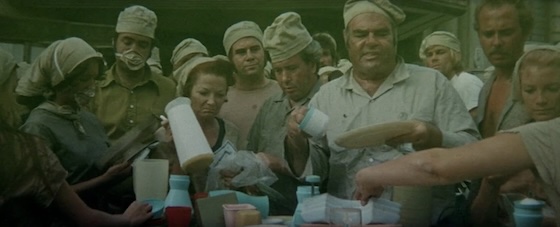
Detective Robert Thorn (Charlton Heston) is assigned to investigate the murder of wealthy executive William R. Simonson (Joseph Cotten). Sharing what amounts to an oversized broom closet with his aging friend Solomon Roth (Edward G. Robinson, who quietly walks away with the entire movie), Thorn isn't exactly the noble detective we've come to expect. He's just as interested in raiding the victim's apartment for soap, vegetables, and books as he is solving the crime. In a world where lettuce might as well be gold bullion, morality becomes negotiable. What begins as a routine murder investigation slowly evolves into something much larger as Thorn and Sol inch closer to a truth that an entire society has been engineered never to discover.
Soylent Green remains a strange film to talk about because it has never entirely worked...and maybe it never did. The pacing wanders. The tonal shifts can be jarring. Some of its attitudes toward women haven't simply aged poorly—they're fossilized relics of another era. The idea of women being referred to as "furniture" is every bit as uncomfortable now as it should be. Yet none of those flaws erase the film's power. If anything, they make it feel even more like a genuine artifact from a decade trying to imagine where unchecked greed, environmental collapse, and social indifference would eventually lead.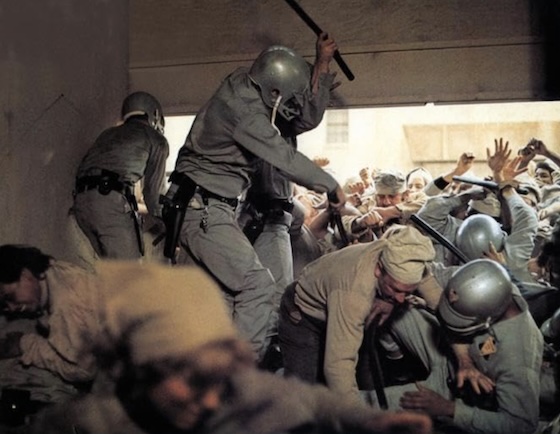
The government offers assisted suicide in beautifully orchestrated farewell ceremonies while the masses line up for another shipment of Soylent Green. The oceans aren't dying anymore. They're already dead. The plankton is gone. Nature has tapped out. The corporations simply found another ingredient to keep production moving.
You already know what it is.
The ending lands exactly the way you expect it to, but that's almost beside the point. Fleischer constructs the entire film like a grimy detective noir buried beneath layers of sweat, smog, and hopelessness. Every frame feels sticky. Every apartment feels overcrowded. Every conversation feels like it takes place in a city that's forgotten what fresh air smelled like. The famous revelation is merely the exclamation point at the end of a story that's been screaming its warning for nearly fifty-five years.
And that's what makes Soylent Green so unnerving in 2026. Back in 1973, it was speculative science fiction. Today it plays more like a list of bad ideas humanity keeps insisting on workshopping. Climate anxiety. Corporate control over food. Economic inequality. Resource scarcity. The details aren't identical, but the trajectory feels alarmingly familiar. The movie hasn't become prophetic because it predicted the future perfectly—it became prophetic because we keep giving it reasons to feel relevant.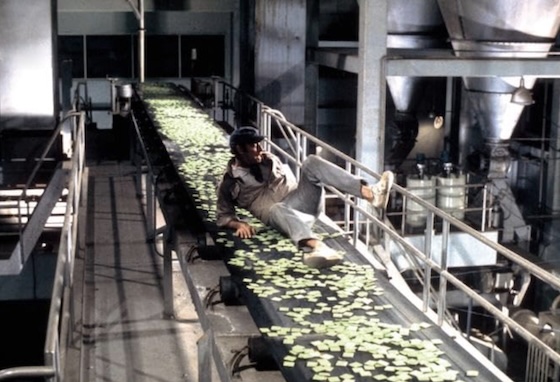
You don't have to be a fan of Charlton Heston—his politics or even his acting—to appreciate what he's doing here. This remains the final chapter of his unofficial science fiction trilogy alongside Planet of the Apes and The Omega Man, and while he's still as gruff and bulldozer-subtle as ever, that weathered quality works in the film's favor. Thorn isn't some polished action hero. He's a man dragging himself through the end of civilization, fighting a battle that was probably lost before he ever showed up.
Make no mistake.
The truth about Soylent Green is still waiting right around the corner.
...although in 2026, I wouldn't be shocked if some startup announced it was "disrupting sustainable protein" and everyone applauded before asking what was actually in it.



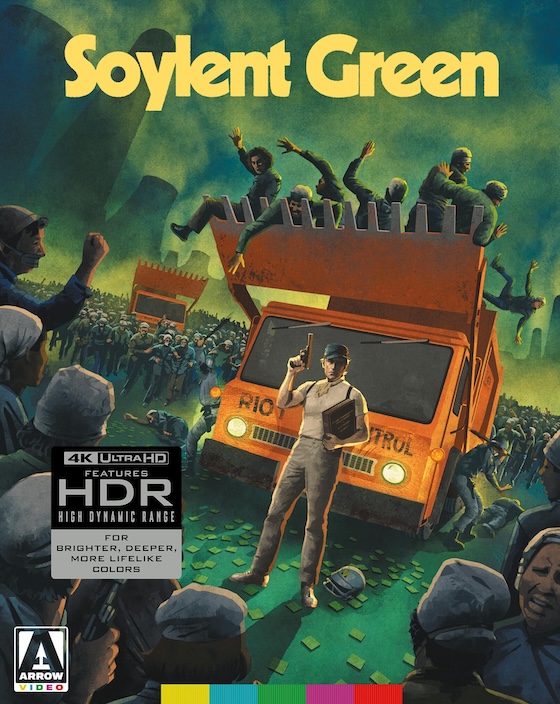
 4K Ultra HD + Limited Edition From Arrow Films
Home Video Distributor: Arrow Films
Available on Blu-ray - July 28, 2026
Screen Formats: 2.39:1
Subtitles: English SDH
Video: Native 4K; Dolby Vision; HDR10
Audio: English: LPCM Mono
Discs: 4K Ultra HD; single-disc set
Region Encoding: 4K region-free
Soylent Green has long since graduated beyond its famous ending. The twist may be one of cinema's worst-kept secrets, but the film's suffocating atmosphere and increasingly uncomfortable relevance continue to resonate more than fifty years after its release. Richard Fleischer crafted a dystopian detective story that has only become more unsettling with age, and Arrow Video has delivered what is easily the definitive home video presentation of the film to date. If you've only known Soylent Green as the punchline to a decades-old joke, this gorgeous 4K release is the perfect reminder that the movie itself is far smarter, darker, and more haunting than its reputation suggests.
VIDEO
Arrow Video absolutely knocks this one out of the park. Sourced from a meticulous 4K restoration of the original camera negative, Soylent Green has never looked this good on home video. This isn't a glossy makeover—nor should it be. The film retains every ounce of its grimy, sweat-soaked, nicotine-stained aesthetic while revealing layers of detail that have been buried on previous releases.
Film grain remains beautifully organic, skin textures are remarkably natural, and the oppressive haze hanging over New York City finally has the depth and dimensionality it always deserved. Blacks are substantially richer without crushing shadow detail, and HDR gives the endless sea of browns, yellows, and sickly greens far more nuance than you'd expect from such an intentionally bleak color palette.
It's still ugly...just gloriously ugly.
AUDIO
Presented in its original mono alongside a respectful lossless restoration, the soundtrack isn't designed to impress with bombast, but it faithfully recreates the atmosphere Fleischer intended. Fred Myrow's haunting score carries surprising warmth while dialogue remains consistently clean and intelligible throughout.
Environmental sounds—the constant crowds, machinery, and suffocating urban noise—create an immersive sense of place without ever overwhelming the mix. Arrow wisely avoids unnecessary tinkering, allowing the film to sound authentic rather than artificially modernized.
Supplements:
Commentary:
- See below
Special Features:
Arrow has assembled a terrific package that treats Soylent Green as the landmark piece of science fiction history it has become. New interviews, scholarly appreciation pieces, archival material, and insightful visual essays dig into everything from Harry Harrison's original novel Make Room! Make Room! to the film's environmental themes, production history, and enduring cultural impact. Edward G. Robinson's emotional final performance also receives thoughtful attention, adding another layer of poignancy to an already unforgettable film. As expected from Arrow, the presentation is rounded out with collectible packaging, an illustrated booklet, and the kind of premium treatment collectors have come to expect from the label.
- Brand new 4K restoration from the original 35mm camera negative by Arrow Films
- 4K Ultra HD (2160p) presentation
- Original lossless mono audio
- Optional English subtitles for the deaf and hard of hearing
- Archive audio commentary with director Richard Fleischer and star Leigh Taylor-Young
- New audio commentary by film historian Michael Brooke and author Johnny Mains
- Charlton Heston at the BFI – archival on-stage interview
- Richard Fleischer at the BFI – archival on-stage interview
- A Look at the World of Soylent Green – vintage featurette
- MGM's Tribute to Edward G. Robinson's 101st Film – vintage featurette celebrating Robinson's final screen performance
- Original theatrical trailer
- Image gallery
- Reversible sleeve featuring original theatrical artwork and newly commissioned artwork by Nathanael Marsh
- Collector's booklet featuring new essays by Frank Collins and Alexandra Heller-Nicholas
As boutique labels go, this is classic Arrow: an excellent restoration, two worthwhile commentary tracks, archival interviews with both Fleischer and Heston, and enough supplemental material to place the film in both its historical context and its continuing relevance more than half a century after its release.

| Movie |  |
|
| Video | |
|
| Audio | |
|
| Extras | |
|
|
Composite Blu-ray Grade
|
||










![Trick or Treat (1986) – 4K Ultra HD [Standard Edition]](/images/resized/images/stories/2026/trick-or-treat-4k_40_40.jpg "Trick or Treat (1986) – 4K Ultra HD [Standard Edition]")