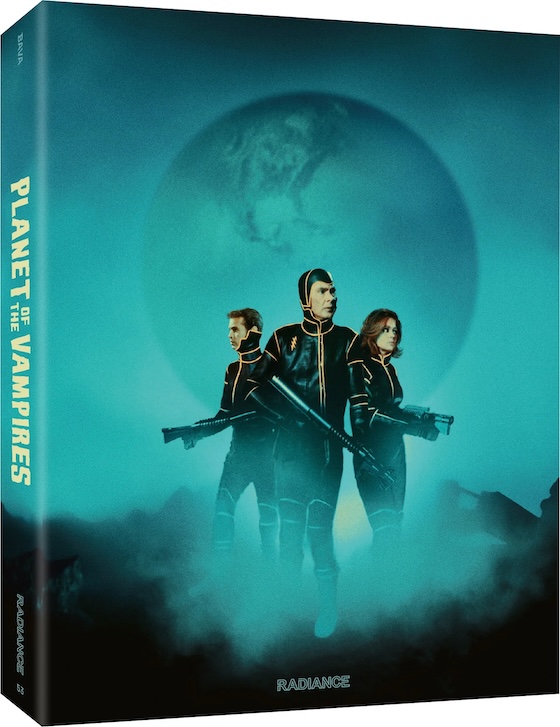
SPACE IS A GRAVEYARD, BABY! AND MARIO BAVA JUST DUG UP THE BODIES!
Forget NASA. Forget mission control. In 1965, Italian horror maestro Mario Bava strapped a bunch of international actors into black leather spacesuits, blasted the scenery with enough colored lighting to give a lava lamp an inferiority complex, fired up the fog machines, and launched the whole damn circus screaming into outer space. The result? Planet of the Vampires, a gloriously unhinged collision of gothic horror, alien possession, and interstellar stupidity that helped write the rulebook for cinematic space nightmares. Holy radioactive hell, what a trip! Twelve years after my original three-star review, I'm ready to admit something: this beautiful bastard has gotten better with age. Or maybe I've just developed a greater appreciation for plastic rocks and leather-clad astronauts. Either way, Bava wins.
Based on Renato Pestriniero's short story "One Night of 21 Hours," the film sends two spaceships, the Argos and Galliott, toward the mysterious planet Aura after receiving a distress signal. Naturally, nobody considers that an unexplored world broadcasting an interstellar cry for help might be a spectacularly bad vacation destination. Upon arrival, the crew goes berserk, corpses start moving, and Captain Mark Markary (Barry Sullivan) discovers that something beneath the planet's swirling fog has developed an unhealthy interest in human bodies. These aren't your grandmother's vampires, either. No fangs. No capes. Just disembodied alien bastards using dead astronauts as rental vehicles and refusing to return them in working condition. It's Night of the Living Dead meets Forbidden Planet, with wardrobe provided by an extraterrestrial fetish convention.
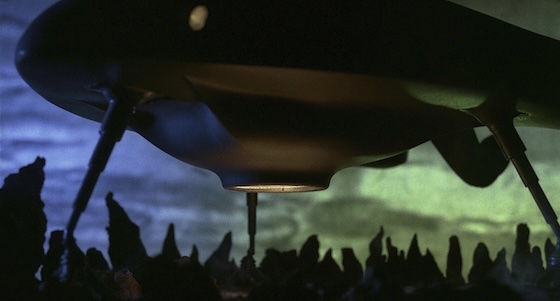
And those images! Sweet mother of Technicolor! Bava turns what looks like forty-seven dollars' worth of miniature spacecraft, painted scenery, and hardware-store leftovers into a psychedelic nightmare that puts considerably more expensive productions to shame. Aura glows red, green, blue, and purple, its rocky landscape disappearing beneath enough artificial fog to shut down Heathrow. The actors wander through it wearing black-and-yellow leather outfits that suggest the X-Men have opened a bondage boutique on Jupiter. None of it should work. All of it does. Bava understood that atmosphere wasn't something you purchased. It was something you manufactured through lighting, composition, and the occasional outrageous act of cinematic bullshit. And nobody manufactured beautiful bullshit quite like Mario Bava.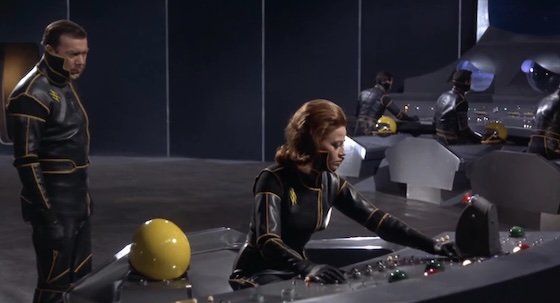
Then come the giant skeletons. OH, THOSE MAGNIFICENT OVERSIZED BASTARDS! When our explorers stumble upon the remains of enormous extraterrestrial beings inside an ancient spacecraft, the cinematic DNA of Ridley Scott's Alien practically jumps off the screen and bites you on the ass. Distress signals! Hostile planets! Deadly discoveries! Human beings making spectacularly poor decisions! Bava got there fourteen years earlier with a fraction of the budget and twice the colored smoke. But reducing Planet of the Vampires to a historical footnote does it a disservice. This is gothic horror blasted into the cosmos, a haunted castle story wearing a space helmet, complete with reanimated corpses, creeping dread, and Gino Marinuzzi Jr.'s electronic score shrieking like a malfunctioning Martian washing machine.
Is it ridiculous? Absolutely. Are the performances occasionally stiffer than the corpses? You bet your leather-covered ass. Does the dialogue sometimes sound like it was translated through three languages and a broken toaster? Without question. But Planet of the Vampires is also a genuinely unsettling, visually intoxicating piece of Italian genre filmmaking, capped by one hell of a nasty little ending. Bava's universe is a place where death is merely a change in management, and the living are too busy looking fabulous to notice the takeover. Radiance Films has now resurrected this cosmic oddity in a deluxe 4K edition, and the timing couldn't be better. The dead are walking. The spaceships are crashing. The fog machines are working overtime. Somewhere in the great beyond, Mario Bava is laughing his ass off.
LONG LIVE THE DEAD!

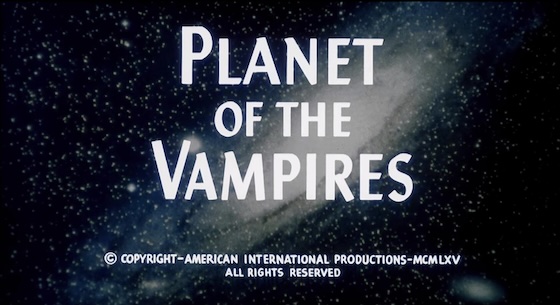

 4K Ultra HD + Blu-ray Limited Edition | Limited to 5,000 copies
Home Video Distributor: Radiance Films
Available on Blu-ray - November 10, 2026
Screen Formats: 1.85:1
Subtitles: English
Video: Native 4K; Dolby Vision; HDR10
Audio: Italian: DTS-HD Master Audio 2.0 Mono; English: DTS-HD Master Audio 2.0 Mono
Discs: 4K Ultra HD; Blu-ray Disc; Two-disc set
Region Encoding: 4K region-free; blu-ray locked to Region A
Two spacecraft answer a mysterious distress signal from the unexplored planet Aura, only to discover a fog-shrouded nightmare where the dead refuse to stay buried. As an alien intelligence begins possessing the bodies of fallen astronauts, the surviving crew must confront an enemy that might already be wearing their friends' faces. Directed by Italian horror legend Mario Bava, Planet of the Vampires is a delirious fusion of gothic terror and pulp science fiction whose extraordinary visual imagination helped pave the way for Alien. Barry Sullivan and Norma Bengell star in this gloriously atmospheric tale of interstellar possession, cosmic paranoia, and really unfortunate wardrobe decisions.
VIDEO
THE FOG! THE COLORS! THE BEAUTIFUL PLASTIC ROCKS! Radiance Films brings Bava's psychedelic nightmare to 4K Ultra HD with a restoration from the original negative, supervised by Lamberto Bava and completed at Fotocinema in Rome in collaboration with CSC Cineteca Nazionale.
Presented with Dolby Vision and HDR, this edition has the technical firepower to showcase the movie's outrageous visual design, from its radioactive reds and eerie greens to those cavernous blacks swallowing the alien landscape. Bava's lighting isn't decoration; it's the whole damn planet. The increased resolution also threatens to expose every miniature, painted backdrop, and gloriously artificial geological formation. Good! Let us see the seams! Half the fun is watching Bava construct an entire extraterrestrial nightmare out of what appears to be leftover Christmas decorations and industrial quantities of fog-machine fluid.
This is exactly the kind of film that deserves preservation rather than digital beautification. Its handmade weirdness is the attraction, not a defect.
AUDIO
SCREAMS FROM THE COSMIC CRYPT! The release offers both Italian and English-language presentations with uncompressed mono audio, preserving the film's wonderfully strange sonic personality. Gino Marinuzzi Jr.'s electronic score is a marvelous collection of sinister pulses, alien vibrations, and shrieking electronic disturbances that sound like someone plugged a haunted synthesizer into the wrong end of a flying saucer.
The dubbing occasionally adds another layer of delightful absurdity, but that's part of the Italian genre-film experience. An alternate Kendall Schmidt score provides an additional listening option for the adventurous. This isn't a movie that needs thunderous surround effects or speakers rattling the furniture. It needs to sound like a distress signal from a dead planet intercepted by a malfunctioning transistor radio.
Mission accomplished in spirit, if not quite in fidelity to anything resembling normal human conversation.
Supplements:
Commentary:
- See below
Special Features:
RADIANCE HAS RAIDED THE DAMN SPACESHIP! My original 2014 Blu-ray arrived with approximately nothing in the supplements department. Not a documentary. Not a commentary. Not even a lonely featurette explaining where Bava bought those ridiculous rocks. Radiance apparently decided to correct that oversight by stuffing its limited edition with enough material to occupy a small interstellar research team. Bava scholar Tim Lucas provides an archival audio commentary, while Dima Ballin and Kat Ellinger's Transmissions from a Haunted World examines the movie's fascinating marriage of gothic horror and science fiction. There's an archival interview with Lamberto Bava, trailer commentaries from Joe Dante and Josh Olson, and a reconstructed seventeen-minute Super 8 version titled Planet der Vampire. Throw in promotional galleries, trailers, an 80-page book, a separate 20-page booklet featuring a new translation of the original short story, six postcards, reversible artwork, and a rigid box, and you've got a release that treats this gloriously deranged B-movie like the cinematic treasure it is. Because, damn it, that's exactly what it is.
- Archival audio commentary by Mario Bava historian Tim Lucas
- Transmissions from a Haunted World – documentary directed by Dima Ballin and Kat Ellinger
- Archival interview with Lamberto Bava
- Planet der Vampire – reconstructed 17-minute Super 8 version
- Trailer commentaries by Joe Dante and Josh Olson
- Original theatrical trailers
- Promotional image gallery featuring materials from the Tim Lucas and Alan Y. Upchurch collection
- Italian and English-language versions of the film
- Alternate Kendall Schmidt score
- 80-page book featuring new and archival writing
- 20-page booklet featuring a newly translated version of Renato Pestriniero's original short story
- Six promotional postcards
- Reversible cover artwork
- Limited-edition rigid-box packaging

| Movie |  |
|
| Video |  |
|
| Audio |  |
|
| Extras |  |
|
|
Composite Blu-ray Grade
|
||