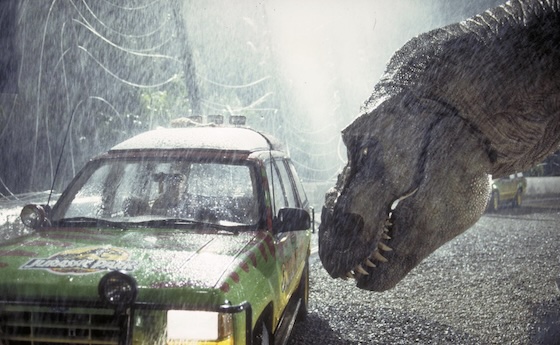
“Hold on to your butts.”
The first time the T. rex steps out of its paddock, the world stops. Rain hammers the glass, the goat leg drops onto the sunroof, and then—those pupils dilate, those nostrils flare, and the king announces himself with a roar that seems to shake the film stock. It’s the kind of sequence that feels engineered in a lab for maximum awe, terror, and spectacle, yet it still plays today with the same ferocity it had in 1993. And the secret isn’t just Spielberg’s direction; it’s Dean Cundey’s eye. His lighting, his framing, his sense of scale—he’s the reason the scene feels mythic instead of mechanical.
Cundey shoots Jurassic Park like a classical adventure epic that wandered into a horror film and decided to stay. His compositions give the dinosaurs weight long before the CGI or animatronics finish the job. The way he uses darkness and rain to reveal the T. rex in pieces—first the claw, then the snout, then the full silhouette—turns the breakout into a slow, operatic unveiling. Spielberg may be the ringmaster, but Cundey is the architect of the awe. It’s his cinematography that keeps the film from aging into nostalgia; it still looks tactile, dangerous, and alive.
What makes Jurassic Park operate as a true classic is how confidently it blends old‑school filmmaking with cutting‑edge effects. Spielberg builds suspense with the patience of a director who grew up on Hitchcock and creature features, not modern blockbusters. He lets the audience lean forward before he knocks them back. The film breathes. It waits. It trusts silence. And when the dinosaurs finally appear, they feel earned—like the payoff to a magic trick performed with absolute conviction.
The cast is a huge part of why the film still lands. Sam Neill’s reluctant‑father energy, Laura Dern’s warmth and steel, Jeff Goldblum’s chaos‑theory swagger, Richard Attenborough’s twinkly hubris—they all inhabit a world that could have easily tipped into camp. Instead, they ground it. They make the wonder feel human. Even the supporting players—Wayne Knight sweating through corporate espionage, Samuel L. Jackson chain‑smoking his way through system failures—add texture to a film that could have coasted on spectacle alone.
Revisiting the movie now, especially in its immaculate 4K restoration as part of the seven‑film Jurassic World collection, you can see every bead of sweat, every ripple in the Rex’s skin, every carefully placed shadow Cundey uses to sell the illusion. The clarity doesn’t expose the seams; it highlights the craftsmanship. The animatronics look better than most modern CGI because they were lit and shot by someone who understood how to make the unreal feel inevitable.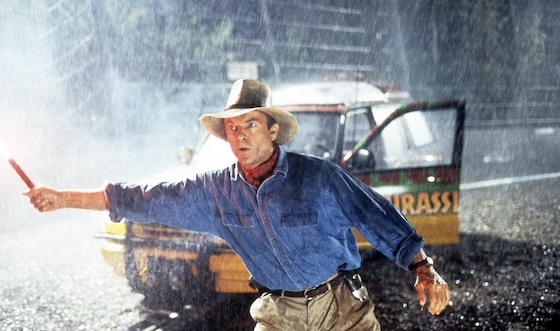
And that’s why Jurassic Park remains Spielberg’s last uncontested classic. Not because he stopped making films, but because this was the final moment when his sense of wonder, his command of suspense, and his instinct for spectacle aligned perfectly with a cinematographer who could translate all of it into images that still feel monumental. The dinosaurs are impressive, the effects revolutionary, but it’s the filmmaking—the Spielberg‑Cundey alchemy—that keeps the park open, decade after decade, roaring just as loudly as the night the T. rex first stepped through the fence.
Think of it this way: Jurassic Park operates like a 1950s creature feature that wandered into the future and stole all the best toys. It’s structured like a classic adventure film—setup, wonder, hubris, chaos, survival—but executed with the precision of a modern blockbuster. Spielberg uses silence as much as spectacle. He lets the audience breathe before he takes their breath away.
It’s the rare film where the technology serves the story instead of the other way around. The animatronics have weight. The CGI has restraint. The editing has rhythm. The danger has teeth.
Seeing it in 4K today is like wiping dust off a fossil and realizing it’s still warm. The textures pop—the rubbery sheen of the raptor skin, the humidity of Isla Nublar, the sweat on Muldoon’s face as he realizes he’s about to be outsmarted by a lizard with a PhD in ambush tactics.
As part of the seven‑film Jurassic World collection, it stands like a monolith. The sequels range from fun to chaotic to “why is this happening,” but the original remains untouchable. It’s the Rosetta Stone of dinosaur cinema.
Jurassic Park is probably the last time a blockbuster felt handcrafted, dangerous, and genuinely enchanted. It’s a film that believes in spectacle but also in characters, in suspense, in the slow burn of anticipation. It’s a reminder of a time - not too long ago - in which movies felt like miracles.
And in 4K, the miracle is sharper than ever.



 4K Ultra HD + Digital 4K Edition
Home Video Distributor: Universal Studios
Available on Blu-ray - September 9, 2025
Screen Formats: 2.39:1; 2.00:1; 1.85:1
Subtitles: English SDH; French; Spanish
Video: 4K; Dolby Vision; HDR10
Audio: English: Dolby Atmos; French: DTS 5.1; Spanish: DTS 5.1; English: DTS:X; French: DTS-HD 7.1; Spanish: DTS-HD 7.1; Spanish: Dolby Digital Plus 7.1; French: Dolby Digital Plus 7.1
Discs: 4K Ultra HD; Blu-ray Disc; seven-disc set
Region Encoding: 4K region-free; blu-ray locked to Region A
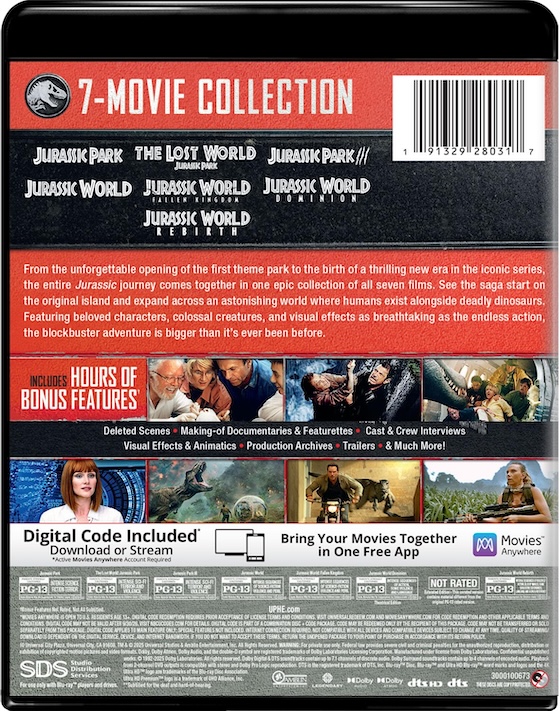
Based on books, ideas, and characters created by author Michael Crichton, all seven films from the groundbreaking franchise are brought together for the first time in the 'Jurassic World: 7-Movie Collection 4K' courtesy of Universal.
The films feature all-star casts that include Sam Neill (Twister'), Laura Dern ('Blue Velvet'), Jeff Goldblum ('The Fly' (1989), Richard Attenborough ('Elizabeth'), Julianne Moore ('Chloe'), and Vince Vaughn ('Swingers'), who appear in the 'Jurassic Park' films; Chris Pratt ('Guardians of the Galaxy') and Bryce Dallas Howard (Pete's Dragon') who lead the three 'Jurassic World' films; and Scarlett Johansson ('Black Widow', 'The Phoenician Scheme'), Jonathan Bailey ('Wicked', 'Bridgerton'), and Mahershala Ali ('Green Book', 'House of Cards') who helm the latest film, 'Jurassic World: Rebirth'.
All meaningful legacy features have been brought forward to this seven-disc set, 'Jurassic World' includes a few new extras, and the films boast excellent technical specifications. An embossed slipbox and a Digital Code redeemable via Movies Anywhere are also included, but Blu-ray discs are not.
VIDEO
This new 7‑film collection doesn’t just gather the entire Jurassic Park and Jurassic World saga—it elevates it. Every movie has been remastered with a dramatic video uptick that brings the franchise’s most iconic moments to life with newfound clarity. Shadows are deeper, colors richer, and the dinosaurs—practical and digital alike—look sharper and more textured than ever.
The original Jurassic Park especially benefits from the upgrade: Dean Cundey’s legendary cinematography finally breathes in full dynamic range, revealing details long buried in older transfers, from the glistening rain on the T. rex’s skin to the subtle interplay of light and shadow in the raptor kitchen. The result is a visual experience that feels both faithful and revitalized, preserving the tactile magic of the original effects while giving the entire series a modern cinematic sheen.
Whether you’re revisiting the park or exploring it for the first time, this is the clearest, most immersive way to witness three decades of dinosaur filmmaking.
AUDIO
The audio has undergone a full‑scale evolution for this release, delivering a richer, more immersive soundscape that transforms every roar, rumble, and whispered warning. The upgraded mix brings new depth to the franchise’s most iconic moments—from the thunderous footsteps of the T. rex to the electric snap of raptor claws against stainless steel.
Dialogue is cleaner, effects are sharper, and the low‑end finally has the muscle these films have always deserved. But the real revelation is John Williams’ legendary score, now presented with a clarity and warmth that lets every soaring theme and trembling motif shine. The brass swells with newfound power, the strings shimmer with detail, and the quiet, suspense‑laden passages feel more intimate than ever. It’s a full audio glow‑up that honors the original recordings while giving the entire saga a cinematic presence that fills the room.
Whether it’s awe, terror, or pure adventure, the sound of Jurassic Park has never felt this alive.
Supplements:
Commentary:
- None
Special Features:
The Jurassic Park special features offer a deep dive into the film’s groundbreaking creation, beginning with the three‑part Return to Jurassic Park documentary, which traces the industry‑shifting leap to CGI, the meticulous soundstage‑driven production design, and the rapid‑fire evolution of digital effects that reshaped the movie day by day. Archival materials preserve the film’s original legacy through an extensive making‑of documentary, vintage promotional featurettes, on‑set footage of Spielberg at work, and a brief look at the crew weathering Hurricane Iniki during location shooting. Additional behind‑the‑scenes content includes early production meetings, location scouting, Phil Tippett’s stop‑motion animatics, ILM’s before‑and‑after VFX comparisons, Foley sessions, storyboards, production archives, the original theatrical trailer, and even a short featurette on the Telltale game—collectively forming a comprehensive portrait of how a cinematic milestone was built from the ground up.
- Return to Jurassic Park: Dawn of a New Era (HD, 25:25) – Explores the pivotal shift to CGI and how it transformed the film’s effects strategy.
- Return to Jurassic Park: Making Prehistory (HD, 20:16) – Focuses on the film’s production design and soundstage work, including stop‑motion previs footage.
- Return to Jurassic Park: The Next Step in Evolution (HD, 15:03) – A deeper look at the rapid development and late‑stage compositing of the film’s groundbreaking CGI.
- The Making of Jurassic Park (SD, 49:39) – A comprehensive, classic overview of the film’s production.
- Original Making‑of Featurette (SD, 4:50) – A brief promotional piece likely used theatrically.
- Steven Spielberg Directs Jurassic Park (SD, 9:07) – On‑set and on‑location footage of Spielberg at work.
- Hurricane in Kauai (SD, 2:09) – A look at the crew enduring Hurricane Iniki during location shooting.
- Early Pre‑Production Meetings (SD, 6:20)
- Location Scouting (SD, 1:59)
- Phil Tippett Animatics: Raptors in the Kitchen (SD, 3:04)
- Animatics: T‑Rex Attack (SD, 7:21)
- ILM Before & After Visual Effects (SD, 6:32)
- Foley Artists (SD, 1:25)
- Storyboards
- Production Archives
- Theatrical Trailer (SD, 1:18)

| Movie |  |
|
| Video | |
|
| Audio | |
|
| Extras |  |
|
|
Composite Blu-ray Grade
|
||











![Trick or Treat (1986) – 4K Ultra HD [Standard Edition]](/images/resized/images/stories/2026/trick-or-treat-4k_40_40.jpg "Trick or Treat (1986) – 4K Ultra HD [Standard Edition]")