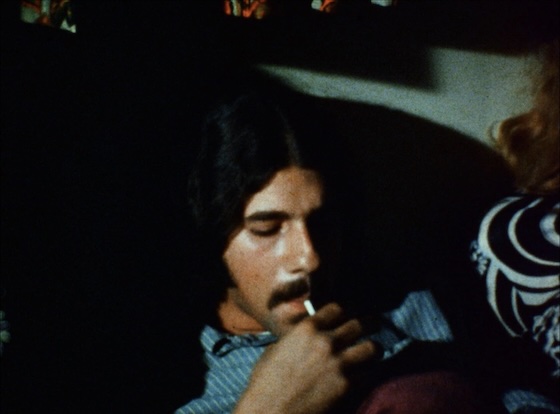
The Psychedelic Priest feels less like a movie and more like something half-remembered after a long, dehydrated drive—sunburnt, drifting, and just a little unreal at the edges. Where The Hooked Generation festers, this one floats, but it’s a sickly float, like heat shimmer off asphalt. William Grefé trades the suffocating interiors for open roads and wandering bodies, but the sludge doesn’t disappear—it thins out, spreads wide, seeps into the gaps between scenes.
You’ve got this pseudo-messianic hitchhiker—literally named John, a Jesus figure drifting through counterculture America—except instead of revelation, it’s all fragments. Conversations that start like they might mean something and then just… dissolve. People talking about love, freedom, enlightenment, but it all lands with a strange hollowness, like everyone’s already burned through whatever truth they were chasing.
The grime here isn’t sweat-soaked rooms—it’s spiritual residue. Long stretches of road, dead air between encounters, a sense that the film is searching for meaning and only finding echoes. The structure barely holds together; it wanders, digresses, forgets where it was going. But that’s the texture. It’s not incompetence so much as a kind of exhaustion baked into the film’s bones.
The HD upgrade does this weird trick where the sunshine doesn’t cleanse anything—it just exposes how empty everything feels. Blue skies, open landscapes, bright daylight… and underneath it, a low-grade aimlessness that never lifts. Faces are clearer, but the expressions don’t resolve. If anything, the clarity makes the detachment sharper, like you can see people thinking and coming up blank.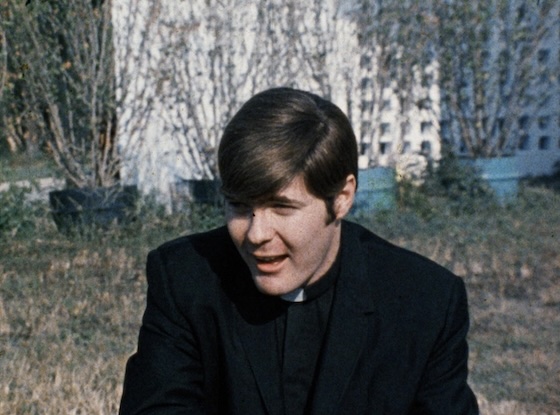
And the audio—same deal. Cleaner, but not comforting. Voices feel isolated in space, like they’re not quite connecting with each other, just drifting past. Silences stretch. Ambient noise creeps in. It’s less a conversation than a series of transmissions that never quite land.
For the D-movie crowd, this one hits differently than The Hooked Generation. That film traps you in a room that smells wrong. The Psychedelic Priest puts you on a road that goes nowhere and makes you sit with it. It’s looser, stranger, more introspective in a way that almost collapses in on itself. Not a descent into chaos, but a slow evaporation of purpose.
It doesn’t feel dangerous—it feels lost. And somehow, that lingers just as much.


Home Video Distributor: Arrow Films
Available on Blu-ray - November 24, 2020
Screen Formats: 1.85:1
Subtitles: English SDH
Video: 1080p
Audio: LPCM Mono
Discs: Blu-ray Disc; 4-disc set
Region Encoding: Region-free playback
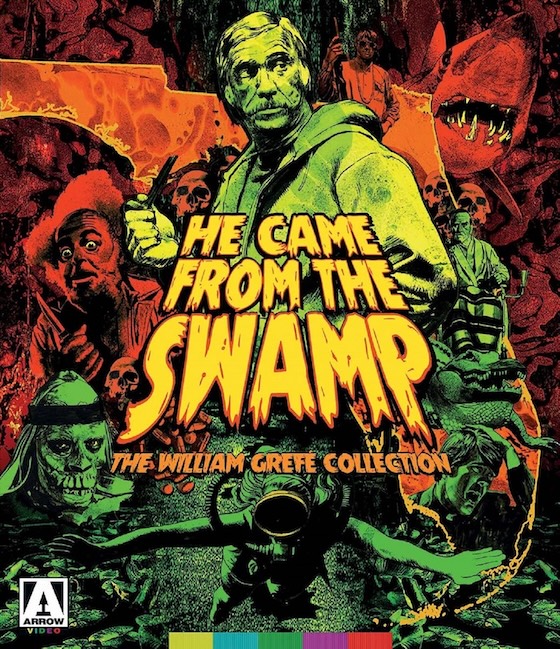
Killer sharks and human jellyfish and living mummies, oh my! Arrow Video is proud to present the first ever collection of works by William 'Wild Bill' Grefé, the maverick filmmaker who braved the deep, dark depths of the Florida everglades to deliver some of the most outrageous exploitation fare ever to go-go dance its way across drive-in screens. Bringing together seven of Grefé's most outlandish films, plus a feature length documentary on the filmmaker's career, He Came from the Swamp: The William Grefé Collection packs in a macabre menagerie of demented jellyfish men (Sting of Death), zombified witch doctors (Death Curse of Tartu), homicidal hippies (The Hooked Generation) and seductive matrons (The Naked Zoo) – not to mention the ubiquitous go-go dancing – to create one of the most wildly entertaining box-sets of all time!
Video
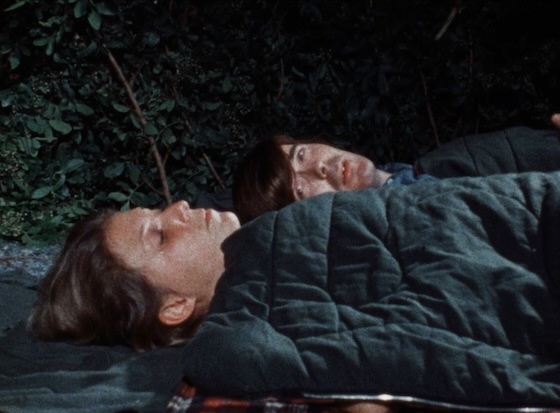
The video glow-up on The Psychedelic Priest is a strange kind of upgrade—less about beautifying the image and more about revealing how thin and sun-bleached it always was.
The HD transfer sharpens the daylight into something almost harsh, where the skies feel too wide and the landscapes stretch out with a kind of empty clarity that mirrors the film’s drifting soul. Colors don’t explode; they fade with intention—dusty blues, washed-out earth tones, skin that looks genuinely tired rather than cinematically lit.
You start noticing textures that used to blur together: the grain sitting on the horizon, the slight wobble of handheld shots, the way light flattens everything instead of giving it depth. It’s cleaner, but that cleanliness makes the film feel even more exposed, like there’s nowhere left to hide the aimlessness. Instead of turning it into something polished, the restoration doubles down on the openness, letting the emptiness breathe in full resolution.
Audio
The audio upgrade on The Psychedelic Priest doesn’t so much clarify the film as it isolates it. Dialogue comes through cleaner, but it feels oddly detached—voices hang in the air like they’re not anchored to anything, drifting across scenes the same way the characters drift across the road.
You start to hear the gaps more than the words: long pauses, awkward overlaps, the soft intrusion of wind, tires on pavement, distant ambient hum that used to blur into the background. Even the music cues feel less like guidance and more like fragments cutting in and out of a signal.
It’s not immersive in a warm way—it’s exposing, stripping away the haze so you’re left with the loneliness baked into every exchange. The upgrade doesn’t pull you closer to the characters; it makes you aware of the space between them, and how little ever really connects.
Supplements:
Arrow packs the disc with the kind of special features that feel like they were dredged straight from the Everglades, cleaned off just enough to be watchable, and then handed to you with a wink. You get a lively, affectionate documentary that digs into William Grefé’s wild career, complete with stories of shooting in alligator‑infested waters and wrangling actors who were only mostly sure what they’d signed up for.
There are interviews with cast and crew who recall the production with equal parts pride and disbelief, plus archival materials that showcase the film’s original marketing—posters, lobby cards, and trailers that promise far more danger than the budget could ever deliver.
Add in a commentary track that feels like sitting on a porch with a filmmaker who’s seen some things, a handful of featurettes exploring Florida’s regional filmmaking scene, and a restoration comparison that proves just how much swamp‑gunk Arrow scraped away. It’s a treasure trove of weirdness, history, and pure cult‑cinema charm.
Commentary:
- See Special Features.
Special Features:
Disc Two: THE HOOKED GENERATION (1968) + THE PSYCHEDELIC PRIEST (1971)
- Introductions to both films by William Grefé
- Archival audio commentaries for both films with William Grefé and Frank Henenlotter
- Beyond the Movie: That’s Drugsploitation! — a look at the counterculture films that inspired The Hooked Generation, with author/film historian Chris Poggiali
- Beyond the Movie: The Ultimate Road Trip — the story behind The Psychedelic Priest, with Chris Poggiali
- The Hooked Generation behind-the-scenes footage
- The Hooked Generation still gallery

| Movie |  |
|
| Video |  |
|
| Audio | |
|
| Extras | |
|
|
Composite Blu-ray Grade
|
||









![Trick or Treat (1986) – 4K Ultra HD [Standard Edition]](/images/resized/images/stories/2026/trick-or-treat-4k_40_40.jpg "Trick or Treat (1986) – 4K Ultra HD [Standard Edition]")