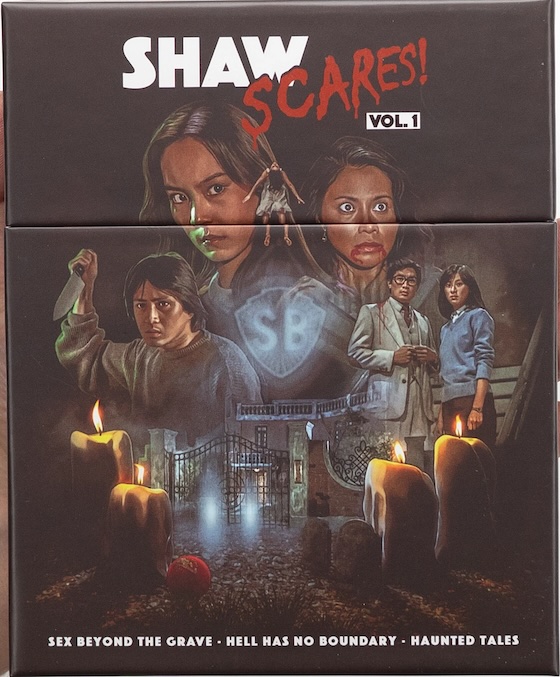
Co-directed/co-written by Chor Yuen (Intimate Confessions of a Chinese Courtesan) and Mou Tun-Fei (Men Behind the Sun), this Shaw Brothers Studio oddity doesn’t just give you Haunted Tales—it gives you two completely different nightmares duct-taped together and told to behave. They do not behave. One whispers like a ghost story told at midnight. The other kicks the door down, steals your wallet, and turns into something unspeakable. Somewhere in the middle, coherence dies quietly and is never mentioned again.
First up: “The Ghost”—a resurrected film Frankenstein’d together from the corpse of an unfinished movie (Hellish Soul), stitched, shocked, and sent shambling back into existence. Newlyweds (Ling Yun and Ching Li) move into a seaside home where the vibes are immediately illegal. The neighbors? Sleep all day like they’re charging in coffins. The animals? Also asleep. Reality? On life support. Then come the visions—slow, creeping, wrong. A car crash detonates out of nowhere. A ghost clocks back in from the afterlife. And yes—there’s an eyeball in the closet, just hanging out like it pays rent. It’s eerie, classical, almost polite horror…if “polite” means “quietly rotting from the inside out.”
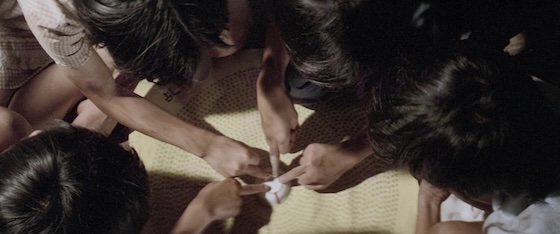
Then the film snaps in half and out spills “The Prize Winner”, a segment that feels like it was written by a fox spirit with a grudge and a sense of humor. Enter janitor Ah Cheng (Chan Shen), who confiscates a spirit board from some kids and accidentally signs a supernatural contract with a fox demon that offers him everything—wealth, luck, the cosmic jackpot—as long as he follows three rules: no gambling, no casual sex, no murder. Reader, he speedruns all three like he’s chasing a high score.
From there, the movie goes fully feral. We’re talking horny chaos, slapstick sinning, and then—like a trapdoor opening beneath your feet—a finale so grotesque it feels like the universe itself is offended. The Ouija board isn’t a board; it’s a machine. A giant spinning disk of doom that whirls faster and faster until fate—and flesh—get processed. Transformation occurs. Meat metaphors become literal. Somewhere nearby, a neighbor casually maintains an apartment filled wall-to-wall with uncanny dolls, as if that’s a normal Tuesday hobby.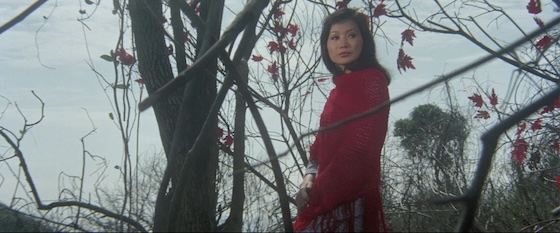
Vinegar Syndrome didn’t just stumble across Haunted Tales—they hunted it. Shaw Brothers horror titles have always been a weird, slippery category: not as internationally famous as their kung fu films, not as widely circulated, and often trapped in rights purgatory. For decades, a lot of these supernatural oddities existed only in murky VHS transfers, bootlegs, or half‑rotted prints floating around Asia.
But in the last few years, Shaw Brothers’ massive film library—thousands of titles—finally started getting properly licensed out to boutique labels. Celestial Pictures, who control the Shaw catalog, began opening the vaults to companies who actually care about preservation. And Vinegar Syndrome? They’re basically the Indiana Jones of sleaze cinema. If there’s a moldy film canister in a basement somewhere, they’re already halfway through the door with a flashlight and a restoration plan.
Vinegar Syndrome, bless their chaotic hearts, resurrects this thing with a restoration so crisp it almost feels disrespectful to the film’s natural grubbiness. The original camera negative scan makes every fog machine belch, every spectral groan, and every mahjong tile clack feel like it’s happening right next to your ear. The unaltered film-sourced soundtrack adds that perfect layer of analog grime, like the movie itself is whispering, “You’re watching something you probably shouldn’t.
Do these two stories fit together? Absolutely not. They orbit each other like mismatched planets, one steeped in gothic dread, the other drunk on supernatural absurdity. But that’s the magic. It shouldn’t work—and yet it does, like a cursed double feature beamed in from a dimension where tone is optional and imagination is unlicensed. I want ten more movies exactly like this. I also never want to see anything like this again. That’s Haunted Tales: a beautiful, baffling, brain-melting contradiction.

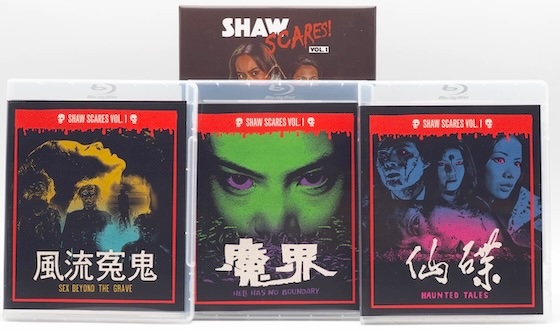

 Blu-ray Edition - Limited to 8,000 copies
Home Video Distributor: Vinegar Syndrome
Available on Blu-ray - November 25, 2025
Screen Formats: 2.35:1; 1.85:1
Subtitles: English SDH
Video: 1080p
Audio: Cantonese: DTS-HD Master Audio Mono
Discs: Blu-ray Disc; three-disc set
Region Encoding: Locked to Region A
From the legendary Shaw Brothers Studio comes a deliriously demented double-feature of supernatural shockers that pushes classic ghost storytelling into the realm of the bizarre. Directed by Yuen Chor and Tun-Fei Mou, Haunted Tales delivers two long-lost nightmares—rescued, reassembled, and unleashed in all their eerie, outrageous glory.
In “The Ghost,” newlyweds (Ling Yun and Ching Li) move into a seaside home where the living sleep by day and something far more sinister stirs by night. As visions intensify and reality fractures, a tragic accident gives way to a chilling return from beyond—and a haunting that refuses to stay buried.
Then, in “The Prize Winner,” a lowly janitor (Chan Shen) stumbles upon a spirit board inhabited by a seductive fox demon offering limitless fortune—with just a few deadly conditions. But when temptation takes hold, the consequences spiral into a frenzy of supernatural excess, grotesque transformations, and a jaw-dropping finale that must be seen to be believed.
Blending atmospheric chills with wild, anything-goes insanity, Haunted Tales is a one-of-a-kind horror oddity where gothic dread collides with outrageous spectacle. Beautifully restored and presented uncut, this long-sought cult curio is essential viewing for fans of boundary-pushing genre cinema.
Video
First off, the transfer is a massive leap over older bootlegs and murky rips that used to be the only way to see this film. Colors finally pop—those moody blues, sickly greens, and candlelit interiors actually look intentional instead of accidental. The image is cleaned up but not scrubbed to death, meaning you still get that rich film grain that keeps it feeling like a proper Shaw Brothers production instead of a wax museum version of one. Detail-wise, it’s a revelation. Textures in costumes, set design, and especially the more grotesque elements (you’ll know exactly when) are sharper and more defined. The darker scenes—crucial for a movie that lives in shadows and fog—hold together much better, with less crushing and more visible depth, so you can actually see what nightmare is unfolding instead of guessing at it.
Audio
Audio gets a solid bump too. The original mono track is cleaned up nicely, with dialogue clearer and the eerie score given more room to breathe. It’s not a modern remix—it still sounds period-authentic—but it’s far less tinny and muffled than older versions floating around.
Supplements:
While short on extras, the commentary is just a plethora of film history talking about everything from Whale to the actors to Pre-Code history and much more. It more than compliments the film well.
Commentary:
-
See below!
Special Features:
This isn’t a barebones dump—Vinegar Syndrome leans into the film’s weird production history and cult status, giving context that actually enhances how you watch it. The commentary especially helps make sense of why the movie feels like two different realities stitched together—because it literally is.
- 3-Disc Region A Blu-ray Set40-page perfect-bound book includes essays by John Charles and Keith Allison
- Newly scanned and restored in 4K from its 35mm original camera negative
- Commentary track with Lance Schibi and Erica Shultz of the Unsung Horrors podcast“Adapting Liminal Home into Haunted Tales” (12 min) – an interview with screenwriter Alex Cheung & Teddy Robin

| Movie |  |
|
| Video |  |
|
| Audio | |
|
| Extras | |
|
|
Composite Blu-ray Grade
|
||









![Trick or Treat (1986) – 4K Ultra HD [Standard Edition]](/images/resized/images/stories/2026/trick-or-treat-4k_40_40.jpg "Trick or Treat (1986) – 4K Ultra HD [Standard Edition]")