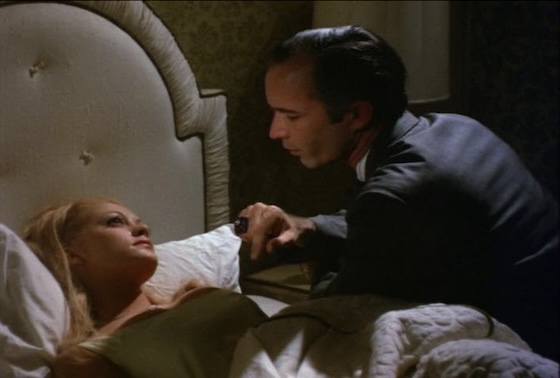
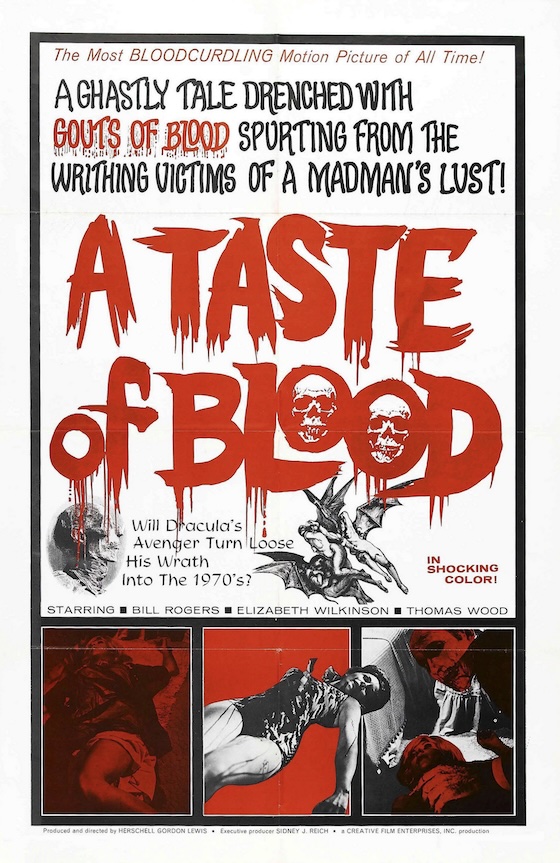
There are movies about vampires, and then there are movies that feel like a vampire bit into a bottle of cheap red wine, staggered through a Florida strip mall, and accidentally filmed a revenge opera on 16mm. A Taste of Blood is the latter. This is not simply a film — it’s a two-hour delirium tremor of gothic ambition colliding head-on with exploitation filmmaking.
Directed by splatter king Herschell Gordon Lewis, the same mad alchemist behind Blood Feast, this film asks a bold question: what if Dracula possessed a middle-class American businessman with the emotional range of a tax return and the patience to deliver a Shakespearean monologue before every murder?
The answer: 117 minutes of hypnotic, rambling, blood-soaked weirdness.
The plot — if we can call this slow-motion séance of dialogue a plot — begins when mild-mannered John Stone purchases a mysterious antique wine cabinet in Europe. Inside: dusty bottles filled not with Bordeaux, but the concentrated hemoglobin essence of Count Dracula himself. Naturally, he drinks it. Because when you find mysterious blood wine in a creepy cabinet, the only logical response is to uncork the curse and chug.
Soon the spirit of Dracula takes the wheel of Stone’s personality like a gothic Uber driver, sending him on a revenge tour against the descendants of the people who killed the count centuries earlier. This revenge plan unfolds with the speed and urgency of a funeral procession stuck behind a tractor.
But pace is not the point here.
The point is Lewis’ sheer unfiltered audacity. The movie stretches scenes until they become surreal endurance tests. Characters deliver speeches that feel like they were written by someone who just discovered the word “vengeance” and decided to use it every thirty seconds. Murders happen with a strange politeness, as though Dracula attended finishing school before committing homicide.
And then there’s the atmosphere — a fascinating collision between gothic horror and Florida living-room theater. Castles are replaced with suburban interiors that look like they belong in a furniture catalog for haunted accountants. Dramatic confrontations occur in rooms lit like insurance commercials.
Yet somehow it works.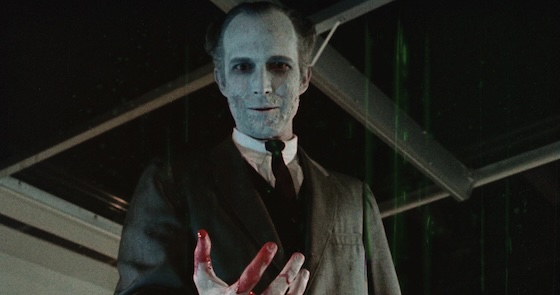
Not because it’s polished. Not because it’s terrifying. But because the film radiates pure, untamed drive-in insanity. Lewis clearly wanted to make a grand, operatic vampire epic — the kind Hammer Studios might attempt — but he did it with pocket change, regional actors, and a script that behaves like it drank the same blood wine as the protagonist.
The result is hypnotic. Scenes linger too long. Dialogue spirals into theatrical monologues. The revenge narrative drifts in and out like a ghost trying to remember why it entered the room.
And that runtime — nearly two hours — turns the experience into something almost experimental. The movie stops being a conventional horror story and becomes a slow-burn cult artifact, the cinematic equivalent of discovering a cursed diary and deciding to read every page.
Bill Kerwin’s performance as John Stone deserves special recognition. He plays the role with a straight-faced seriousness that borders on cosmic comedy. As Dracula’s influence grows, Kerwin doesn’t chew the scenery — he politely nibbles on it while delivering lines like he’s auditioning for Hamlet in a bowling alley.
The violence is tame compared to Lewis’ more notorious splatter outings, but the spirit of exploitation cinema still pulses through every frame. It’s a movie made by someone who believed that if you keep filming long enough, eventually you’ll capture something legendary.
And he kind of did.
A Taste of Blood isn’t good in the traditional sense. It’s better than good — it’s bizarre, stubborn, and gloriously excessive. It’s the kind of film that could only exist in the strange ecosystem of 1960s drive-in horror, where ambition routinely outran budget and filmmakers followed their weirdest instincts straight into cult immortality.
Watching it feels like opening that antique cabinet yourself: you expect a quick sip of campy horror, and suddenly you’re two hours deep into a fever dream about vengeance, Dracula, and the eternal mystery of why anyone drinks suspicious antique blood wine.
In the end, Lewis didn’t just make a vampire movie.
He made a gothic revenge saga that wandered off the rails, took a scenic detour through exploitation cinema, and came back carrying a bottle of pure cult madness.

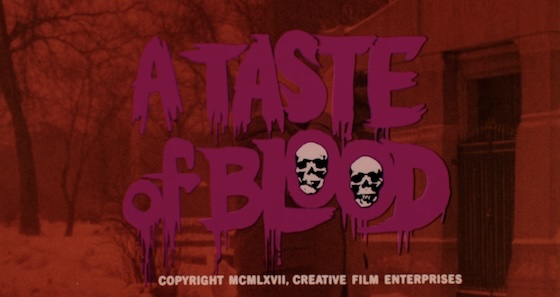

Home Video Distributor: Arrow Films
Available on Blu-ray - November 10, 2020
Screen Formats: 1.85:1
Subtitles: English
Video: 1080p
Audio: LPCM Mono
Discs: Blu-ray Disc; seven-disc-set
Region Encoding: Locked to Region A
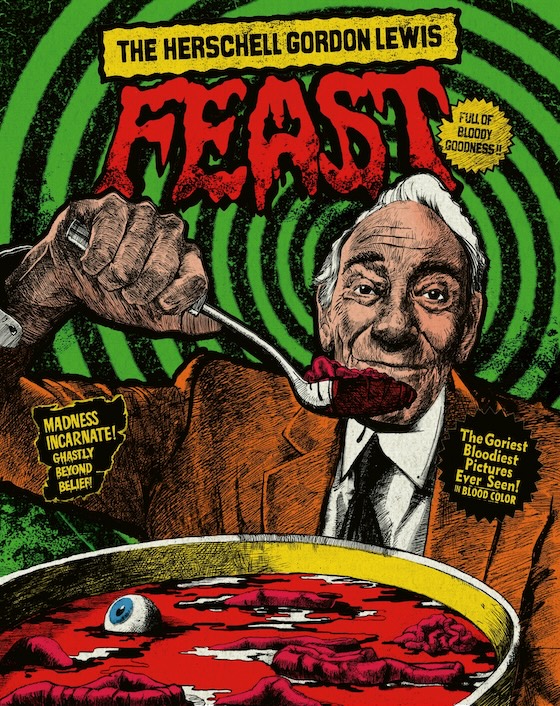
When Arrow resurrected the Herschell Gordon Lewis Feast Blu‑ray box set, it wasn’t just a re‑release — it was a full‑scale archaeological dig conducted by maniacs who love cinema too much to let its weirdest artifacts rot in the swamp. Bursting with lurid color, outrageous performances, and scalp-crawling special effects, A Taste of Blood delivers exactly what its title promises — a gleefully gruesome spectacle that only Lewis could conjure. Presented by Arrow Video in a stunning restoration as part of The Herschell Gordon Lewis Feast, this cult classic remains an essential slice of splatter history — shocking, hilarious, and absolutely hair-raising! The packaging is a riot of lurid artwork, the extras are deep‑cut academic fever dreams, and the whole thing feels like a lovingly curated museum exhibit dedicated to the moment American cinema shrugged off good taste and said, “Let’s see what happens if we show EVERYTHING.” It’s not just a box set — it’s a blood‑drenched celebration of outsider filmmaking at its most gloriously unhinged.
Video
Arrow Video’s treatment of A Taste of Blood—included in the boutique box set The Herschell Gordon Lewis Feast—is exactly the kind of loving restoration exploitation cinema almost never received in its original era. The film appears in a 1080p restoration sourced primarily from the original camera negative, with missing sections reconstructed from 35 mm prints so the most complete version of the film could survive on disc.
The result is surprisingly strong for a $65k regional horror oddity: the image is often crisp and stable, though you can occasionally spot the seams where lower-quality print footage had to fill gaps in the negative. Audio remains limited by the original production’s thin mono track, but Arrow’s cleanup preserves it as clearly as the raw materials allow.
Audio
Arrow’s audio upgrade for A Taste of Blood is necessarily modest but carefully handled. The Blu-ray preserves the film’s original mono soundtrack in a cleaned-up LPCM presentation, removing much of the hiss, crackle, and distortion that plagued earlier home-video releases. Dialogue is noticeably clearer and more stable, though the limitations of the original low-budget recording remain — voices still have that thin, slightly hollow quality typical of regional 1960s productions.
Arrow wisely avoids aggressive filtering, choosing instead to stabilize and clean the track while preserving the film’s authentic sonic texture. The result isn’t a dramatic reinvention of the film’s soundscape but a respectful restoration that makes the movie far easier to listen to than previous transfers. Music cues come through with a bit more presence, background noise is reduced, and the track feels more balanced overall. For a film recorded under the rough-and-ready conditions of Herschell Gordon Lewis’s exploitation productions, the upgrade represents the best the source materials can reasonably deliver, emphasizing clarity and preservation rather than artificial modern enhancement.
Supplements:
Disc Four of The Herschell Gordon Lewis Feast pairs two of 1967’s most deliriously different Lewis outings — the scalp-happy splatter freakout The Gruesome Twosome and the comparatively gothic, talk-heavy vampire oddity A Taste of Blood — and backs them with a generous spread of contextual extras that dig deep into the Godfather of Gore’s outsider artistry.
At the center are introductions and feature-length audio commentaries by Herschell Gordon Lewis himself. Typically wry and disarmingly candid, Lewis reflects on budgets, locations, performers, and the practical realities of regional exploitation filmmaking. His commentaries are less scholarly analysis than carnival-barker memoir — full of dry humor, unapologetic pragmatism, and the kind of blunt self-assessment that only a true independent pioneer could deliver.
The newly produced featurettes broaden the perspective. In “Peaches Christ Flips Her Wig!”, San Francisco drag performer Peaches Christ celebrates The Gruesome Twosome as high camp before camp had a name, unpacking its accidental comedy, outrageous performances, and endurance as midnight-movie gold. “It Came From Florida” finds cult filmmaker Fred Olen Ray discussing the anything-goes spirit of Florida-based productions, situating Lewis within a scrappy regional scene that thrived on hustle over polish.
“Herschell vs The Censors” provides perhaps the most fascinating historical insight, with Lewis recounting battles against local censorship boards, outraged civic groups, and even angry patrons determined to shut his films down. It’s a reminder that these splatter cheapies once provoked genuine moral panic — and that Lewis’ notoriety was as much a marketing weapon as the gore itself.
Rounded out with original trailers for both features — pure, breathless exploitation hype reels — Disc Four’s supplements form an affectionate but clear-eyed portrait of a filmmaker who understood shock value as both art form and business model. Arrow’s curation doesn’t just preserve the films; it captures the showman behind them, scalpels, capes, and all.
Commentary:
- See special features
Special Features:
- DISC FOUR: THE GRUESOME TWOSOME (1967) & A TASTE OF BLOOD (1967)
- Introduction to the films by director Herschell Gordon Lewis
- Audio Commentary on The Gruesome Twosome with Lewis
- Audio Commentary on A Taste of Blood with Lewis
- Peaches Christ Flips her Wig! – the San Francisco performer on The Gruesome Twosome
- It Came From Florida – filmmaker Fred Olen Ray (Scalps) on Florida Filmmaking
- Herschell vs The Censors – Lewis discusses some of the pitfalls involving local censorship and the lengths to which angry moviegoers tried to stop him
- Trailers for The Gruesome Twosome and A Taste of Blood

| Movie |  |
|
| Video |  |
|
| Audio |  |
|
| Extras | |
|
|
Composite Blu-ray Grade
|
||








![Trick or Treat (1986) – 4K Ultra HD [Standard Edition]](/images/resized/images/stories/2026/trick-or-treat-4k_40_40.jpg "Trick or Treat (1986) – 4K Ultra HD [Standard Edition]")