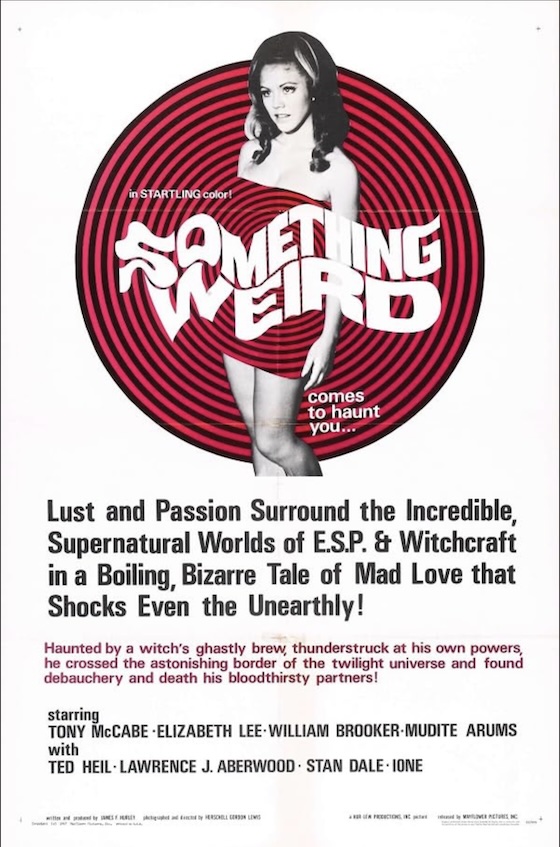
Step right up, sinners and citizens, academics and degenerates. Smell the popcorn grease. Hear the generator coughing behind the tent. In 1967, while respectable cinema was polishing its halo and pretending to discover youth culture, Herschell Gordon Lewis was out back with a cattle prod and a Ouija board, inventing a sideshow séance called Something Weird.
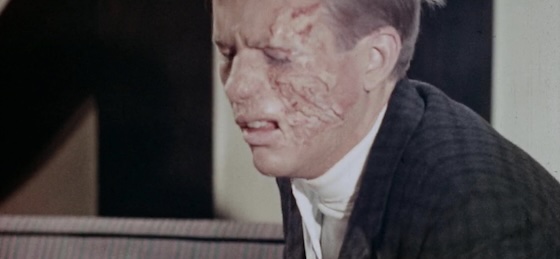
A man gets electrocuted on the job — high voltage handshake with destiny — and instead of dying politely he wakes up psychic. Clairvoyant. Zapped into second sight like a department-store messiah. This is Warren, played by Tony McCabe with the wide-eyed stiffness of a man who suspects the universe has just slipped something into his drink. McCabe doesn’t so much emote as absorb voltage. He stares into middle distance like he’s reading invisible cue cards from God.
Then she appears.
The Witch — played with ice-water composure by Elizabeth Lee — doesn’t enter so much as manifest. She materializes like a subpoena from the underworld, all controlled menace and suburban sorcery. Lee delivers her lines as if they were carved into stone tablets behind a drive-in concession stand. She wants Warren’s powers, and she wants them with the calm determination of someone reorganizing reality’s filing cabinet.
Circling the psychic circus is the straight-laced psychiatrist, portrayed by William Brooker, who approaches the supernatural like it’s a paperwork problem. Brooker gives us the rational world’s nervous smile — a man clinging to science while the curtains catch fire behind him.
What follows lurches and crackles like a carnival ride assembled without instructions: occult rituals staged with PTA enthusiasm, lectures about black magic delivered like courtroom testimony, psychic demonstrations that land somewhere between parlor trick and federal offense. The film detours into nudist-colony anthropology without warning, as if the projector briefly tuned into another forbidden broadcast and decided to stay there.
The acting across the board is magnificently unnatural. Lines are delivered like sworn affidavits. Pauses linger too long. Every exchange feels slightly misaligned from reality, which is precisely why it works. McCabe’s wooden solemnity becomes trance-like. Lee’s glacial calm becomes mythic. Brooker’s rationalism dissolves into polite panic. The stiffness turns into texture; the awkwardness curdles into dream logic.
Lewis directs with the confidence of a man selling miracle tonic from the trunk of a Buick. No subtlety. No polish. Just promise. He shoots everything flat and functional, which somehow makes the witchcraft feel more authentic — as if these events were documented evidence in a trial against modernity. This is exploitation not as trash, but as American folk art. Entrepreneurial cinema. Taboo wrapped in moral-warning tape and sold two tickets at a time.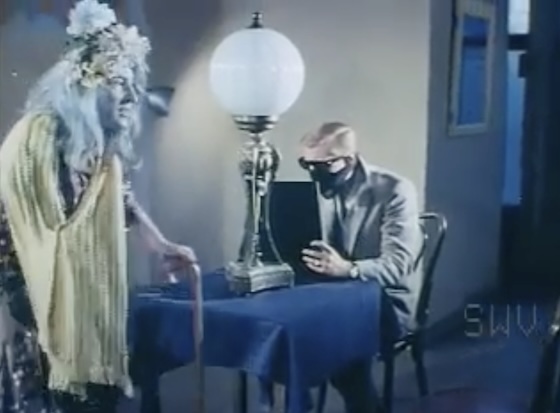
The black-and-white photography gives it the texture of a police report from Hell. Shadows sit in corners like unpaid debts. Faces glow under harsh light as if interrogated by God or an underpaid grip. Nothing is elegant, but everything is committed. You can feel the hustle in every frame — the urgency of a filmmaker who knew he didn’t need perfection. He needed electricity, skin, the occult, and actors willing to stare directly into the void without blinking.
And that’s the true magic trick. Something Weird shouldn’t work. It is uneven, abrupt, stitched together like carnival canvas after a storm. But it hums. It vibrates. It feels alive in a way polished studio pictures often don’t. It sweats. It winks. It promises damnation and delivers spectacle instead.
Watching it feels like discovering a cursed reel in the back of a drive-in projection booth. Like stumbling into a revival meeting where the preacher has replaced salvation with ESP. It is ridiculous and hypnotic at the same time — a neon sermon about power, lust, and the American appetite for forbidden knowledge.
This isn’t respectable cinema. It’s voltage in human form. It’s Elizabeth Lee whispering witchcraft like it’s neighborhood gossip. It’s Tony McCabe blinking at the cosmos. It’s William Brooker clinging to reason as the tent ropes snap.
Step out of the tent when it’s over. The air will feel different. The world slightly off-axis. And somewhere in the distance, you might still hear the generator humming.


Home Video Distributor: Arrow Films
Available on Blu-ray - November 10, 2020
Screen Formats: 1.85:1
Subtitles: English
Video: 1080p
Audio: LPCM Mono
Discs: Blu-ray Disc; seven-disc-set
Region Encoding: Locked to Region A
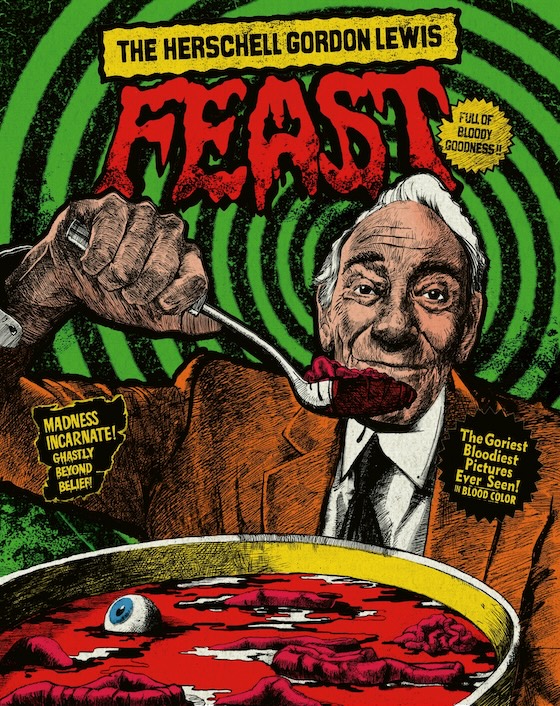
When Arrow resurrected the Herschell Gordon Lewis Feast Blu‑ray box set, it wasn’t just a re‑release — it was a full‑scale archaeological dig conducted by maniacs who love cinema too much to let its weirdest artifacts rot in the swamp. This set arrives like a grindhouse holy text, a lavish, oversized altar to the Godfather of Gore, packed with restorations so crisp you can practically count the brushstrokes on the latex intestines. Arrow treats Something Weird and its deranged siblings with the reverence usually reserved for Bergman or Kurosawa, which is exactly the kind of cosmic joke H.G. Lewis would appreciate. The packaging is a riot of lurid artwork, the extras are deep‑cut academic fever dreams, and the whole thing feels like a lovingly curated museum exhibit dedicated to the moment American cinema shrugged off good taste and said, “Let’s see what happens if we show EVERYTHING.” It’s not just a box set — it’s a blood‑drenched celebration of outsider filmmaking at its most gloriously unhinged.
Video
Decades later, the carnival got a neon polish job thanks to Arrow Films, who treated Something Weird like a lost artifact instead of a punchline and gave it a full boutique resurrection. The blacks are richer, the whites sharper, the grain no longer a swamp but a texture you can practically run your fingers across; suddenly Herschell Gordon Lewis’ bargain-basement witchcraft looks less like a dying drive-in print and more like a deliberate fever dream preserved in formaldehyde.
The audio, once a muffled sermon from the back pew of Hell, crackles with surprising clarity, letting every stiff line reading and occult proclamation land with renewed, glorious absurdity.
Arrow’s restoration doesn’t sand off the rough edges — it frames them in velvet — turning what was once a grimy roadside attraction into a gleaming cult reliquary, proof that even exploitation ephemera can get a cathedral-grade glow-up without losing the smell of popcorn and ozone.
Audio
And then there’s the audio — resurrected with loving perversity by Arrow Films for Something Weird — scrubbed clean but not sterilized, like they exhumed the original magnetic tape from a drive-in graveyard and whispered sweet nothings into its oxide. The hiss that once sounded like frying circuitry is now a controlled atmospheric sizzle; dialogue that used to drift like a ghost through a paper cup telephone snaps forward with startling presence.
Every incantation from Elizabeth Lee lands with cool authority, every wide-eyed declaration from Tony McCabe vibrates with renewed, awkward conviction. The score and ambient hum — that faint electrical buzz that always felt accidental — now plays like intentional mood music, the sonic equivalent of fluorescent lights flickering over a midnight séance.
Arrow didn’t modernize it into slickness; they clarified the chaos, letting the film’s bargain-bin sermons and occult theatrics echo with cathedral-grade fidelity while still preserving the beautiful grime that makes it feel dangerous.
Supplements:
The special features play like a midnight‑movie séance where scholars, weirdos, and exploitation lifers gather to praise the Godfather of Gore. You get archival interviews with Herschell Gordon Lewis himself, where he cheerfully explains how he invented an entire subgenre with pocket change and a pathological disregard for the MPAA. There’s a commentary track featuring Lewis and producer David F. Friedman riffing like two carnival barkers reminiscing about the time they conned America into watching a man hack off limbs with a machete from a hardware store. Arrow also loads the disc with featurettes on the film’s production, the birth of splatter cinema, and the cultural shockwaves that followed. You get outtakes, trailers, radio spots, and the kind of behind‑the‑scenes ephemera that feels like it was rescued from a Florida storage unit moments before the roof caved in. It’s a treasure trove of grindhouse archaeology — a lovingly curated museum of mayhem for anyone who wants to understand how a no‑budget gore flick became a cornerstone of cult cinema.
Commentary:
- See special features
Special Features:
DISC THREE: COLOR ME BLOOD RED (1965) & SOMETHING WEIRD (1967)
- Introduction to the films by director Herschell Gordon Lewis
- Audio Commentary on Color Me Blood Red with Lewis and producer David F. Friedman
- Audio Commentary on Something Weird with Lewis and Friedman
- Color Me Blood Red Outtakes
- The Art of Madness – visual essay on the recurring motif of mad artists as killers in horror cinema
- Weirdsville – film Scholar Jeffrey Sconce on Something Weird
- Lewis on Jimmy, the Boy Wonder, his 1966 children’s musical
- A Hot Night at the Go Go Lounge! – Lewis’ 1966 dance short
- Trailers for Color Me Blood Red and Something Weird

| Movie |  |
|
| Video |  |
|
| Audio |  |
|
| Extras | |
|
|
Composite Blu-ray Grade
|
||