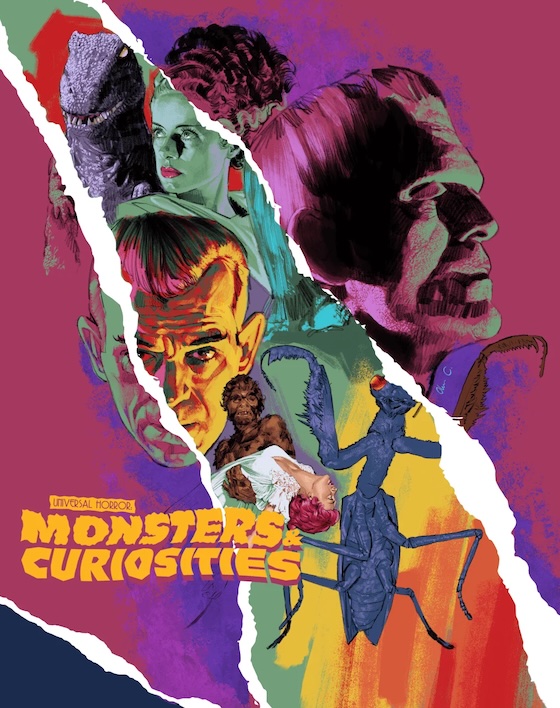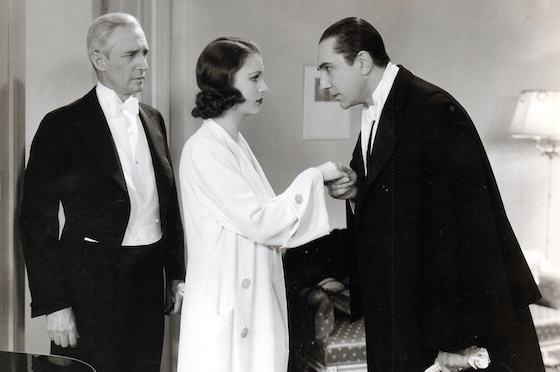
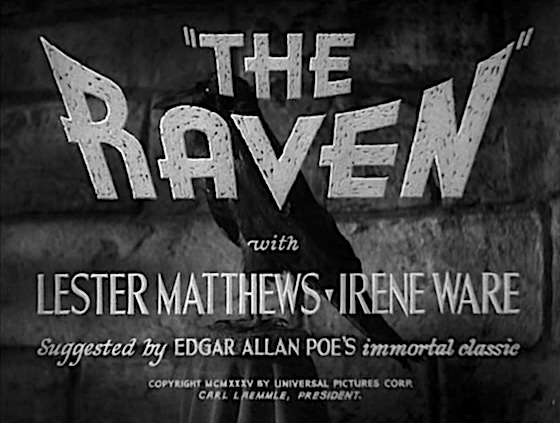
There is absolutely nothing subtle about The Raven. Thank God. By 1935, Universal had Boris Karloff and Bela Lugosi under contract, Edgar Allan Poe's name sitting there begging to be exploited, and audiences apparently willing to watch these two magnificent bastards do just about anything together. So what does Universal do? It gives Lugosi a torture chamber, a Poe obsession, a surgeon's scalpel, and Boris Karloff's face to fuck around with. That's the movie. That's the pitch. And revisiting The Raven in 2026 as part of Karloff and Lugosi's Tales of Gothic Terror – Part One in Umbrella Entertainment's Universal Horror: Monsters and Curiosities (1923–1960) collection, I'm reminded just how gloriously mean this thing is. The Black Cat had sophistication beneath its madness. The Raven doesn't give a shit about sophistication. It wants to get weird.
Lugosi is Dr. Richard Vollin, a brilliant surgeon who saves the life of dancer Jean Thatcher (Irene Ware) after an automobile accident and promptly becomes obsessed with her because apparently performing successful surgery wasn't enough excitement for one evening. Jean's father (Samuel S. Hinds) recognizes immediately that something isn't right with Vollin and tries to put an end to his interest in his daughter. Bad move. Vollin doesn't handle rejection particularly well. He also happens to be completely obsessed with Edgar Allan Poe and has constructed working versions of Poe-inspired torture devices inside his home, including the swinging blade from The Pit and the Pendulum. That's when escaped murderer Edmond Bateman (Boris Karloff) wanders into his life looking for plastic surgery to change his appearance. Vollin agrees, then deliberately disfigures him instead and uses the promise of repairing his face to turn Bateman into his personal weapon. Somewhere Edgar Allan Poe is either applauding or demanding his name be removed from the credits.
And this is Lugosi's movie. Completely. Karloff might have received top billing—because Universal knew exactly whose name was selling tickets—but Lugosi gets the meat and tears into it like a starving man. Vollin allows him to unleash every theatrical instinct Hollywood occasionally tried to beat out of him. The eyes widen. The voice rises. That glorious accent wraps itself around increasingly insane declarations while Vollin becomes more delighted with his own depravity. There's a moment when Lugosi essentially announces that he enjoys torture and the expression on his face tells you everything you need to know: this motherfucker has found his calling. Karloff takes the opposite approach. His Bateman is a killer, yes, but once Vollin mutilates him, something unexpectedly sad emerges. He becomes another Karloff monster trapped inside a face the world will judge before bothering to discover the person underneath. Lugosi gets the fireworks. Karloff gets the humanity. Put them together and the movie catches fire.
The Poe connection is mostly an excuse to fill Vollin's house with nightmare machinery, but who cares when the results are this much fun? Director Lew Landers keeps the picture moving like he knows somebody might come along and confiscate the toys if he slows down. Secret doors open. Walls move. Rooms shrink. People get trapped. A giant pendulum starts swinging. Lugosi becomes increasingly orgasmic about everybody's impending doom while Karloff slowly realizes that maybe being the homicidal maniac isn't enough to make him the worst person in the house. That's what makes The Raven such a delicious companion to The Black Cat. Karloff was the ice-cold evil in that film while Lugosi carried the emotional wounds. One year later, they essentially switch positions. Karloff becomes the wounded creature and Lugosi becomes completely, wonderfully batshit. Universal didn't need Dracula's cape or Frankenstein's electrodes anymore. Give these two actors a room, point the camera at them, and something wicked was going to happen.
Watching The Raven now, its seventy-minute running time feels almost revolutionary. No bullshit. No mythology dump. No two-hour setup for another movie five years from now. Vollin goes crazy, Karloff gets his face mangled, Poe's torture chamber starts humming, and we're off to the races. Is it as visually sophisticated as The Black Cat? No. Is it as psychologically rich? Probably not. Do I care while Bela Lugosi is standing beside a fucking pendulum practically vibrating with happiness because everyone around him is about to die? Not even slightly. The Raven is nasty, pulpy, theatrical, ridiculous, and enormously entertaining—the kind of horror movie that knows exactly what it is and gets the hell out before the party stops being fun. As another chapter in Umbrella's celebration of Karloff and Lugosi, it's also further proof that these two didn't simply belong together on screen. They made each other more dangerous.


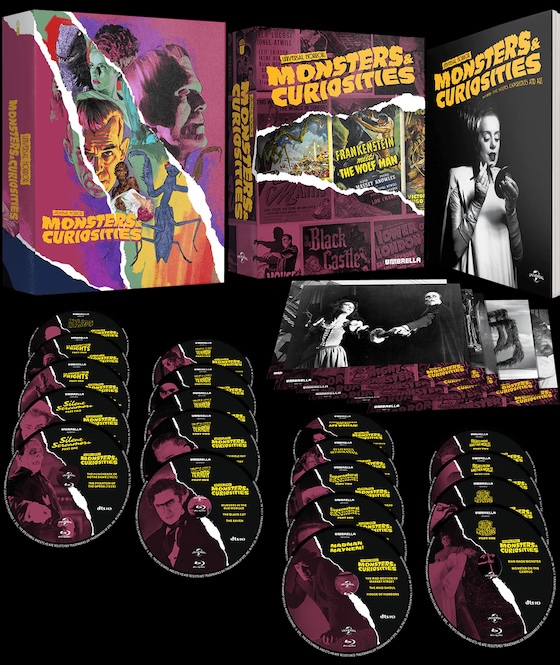
Universal Horror: Monsters And Curiosities Blu-ray - Umbrella Entertainment Exclusive / Collector's Edition
Home Video Distributor: Umbrella Entertainment
Available on Blu-ray - July 1, 2026
Screen Formats: 1.33:1; Various
Subtitles: English SDH
Video: 1080p
Audio: DTS-HD Master Audio 2.0
Discs: Blu-ray Disc; nineteen-disc set
Region Encoding: Locked to Region A
Universal's The Raven (1935) reunites horror legends Boris Karloff and Bela Lugosi for a wonderfully nasty slice of Gothic madness involving obsession, mutilation, revenge, and a house conveniently stocked with working Edgar Allan Poe-inspired torture devices. Lugosi absolutely owns the picture as Dr. Richard Vollin, a brilliant surgeon whose bruised ego sends him gleefully over the edge, while Karloff brings unexpected humanity to the disfigured killer forced into doing his dirty work.
Mean, macabre, fast-moving, and gloriously unhinged, The Raven doesn't have time for subtlety—and that's precisely why it remains so damn entertaining. As part of Karloff and Lugosi's Tales of Gothic Terror – Part One in Umbrella Entertainment's massive Universal Horror: Monsters and Curiosities (1923–1960) collection, this is seventy minutes of vintage Universal horror letting two legends loose and watching the sparks fly.
Video
Umbrella Entertainment's presentation of The Raven gives the film's shadow-heavy photography plenty of room to breathe, with strong contrast and satisfying detail throughout Vollin's increasingly sinister home. The laboratory and torture-chamber sequences are where the transfer really earns its keep, allowing the machinery, stonework, hidden passages, and Karloff's disfiguring makeup to register with impressive clarity while retaining an appropriately film-like appearance.
Blacks are suitably ominous without completely devouring detail, grain remains natural, and the overall presentation serves this nasty little slice of Universal Gothic extremely well.
Audio
The audio presentation keeps things appropriately straightforward, with dialogue remaining clear and the film's score and effects nicely balanced against the performances. That's especially important here because Lugosi's voice is practically a special effect unto itself. Every pause, hiss, declaration, and increasingly manic outburst comes through cleanly, while Karloff's quieter performance retains the necessary weight.
The mechanical sounds of Vollin's torture devices also have enough presence to make the final act work without artificially modernizing a soundtrack that should still sound like 1935.
Supplements:
Commentary:
- None
Special Features:
Within Umbrella Entertainment's Universal Horror: Monsters and Curiosities (1923–1960) collection, The Raven benefits enormously from being positioned alongside the other Karloff and Lugosi collaborations rather than treated as another stray Universal catalog title.
Following Murders in the Rue Morgue and The Black Cat, we get to watch Lugosi evolve from mad scientist to wounded avenger to full-blown sadistic lunatic, while Karloff continues demonstrating how much sympathy he could locate inside characters who should have been irredeemable.
Add the set's hardcover companion book, collector-focused presentation, and the opportunity to experience these films as part of Universal's larger Gothic evolution, and The Raven becomes exactly the kind of rediscovery this massive Umbrella collection was built for.

| Movie |  |
|
| Video |  |
|
| Audio | |
|
| Extras |  |
|
|
Composite Blu-ray Grade
|
||