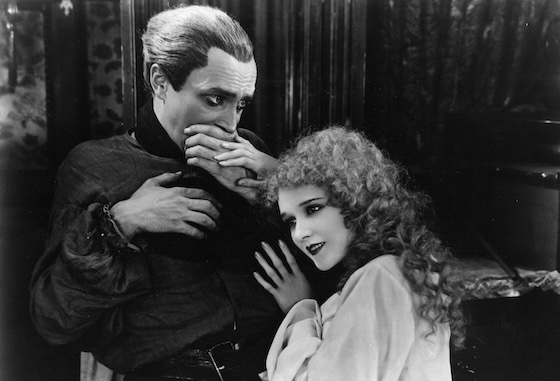
Let's get something straight right out of the gate.
If you've spent your life arguing that the Joker is the greatest comic book villain ever created—and I absolutely have—then you owe a debt of gratitude to a silent film released nearly a century ago. No Gwynplaine. No Joker. Bill Finger acknowledged the influence. Bob Kane embraced it. The image of Conrad Veidt's grotesquely permanent grin became part of Batman mythology long before Gotham City ever existed. Every time the Clown Prince of Crime flashes that impossible smile, he's borrowing from The Man Who Laughs. That's not fanboy speculation. That's cinema history.
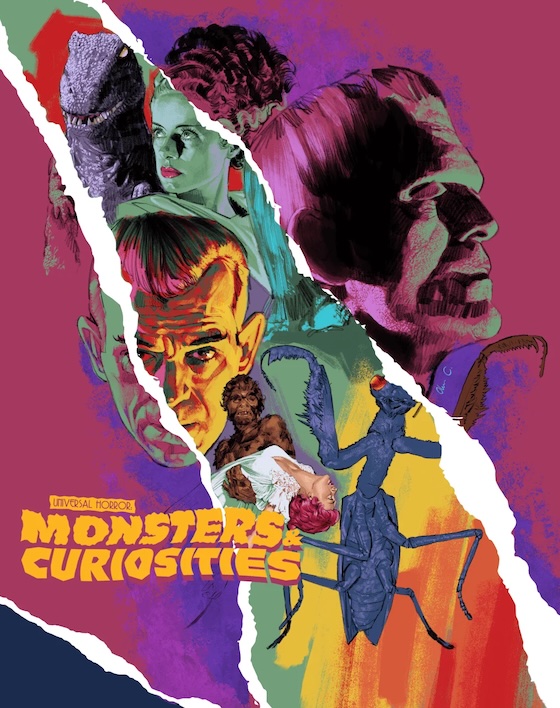
Watching The Man Who Laughs in 2026 as the fourth film in Umbrella Entertainment's outstanding Universal Horror: Monsters and Curiosities (1923–1960) collection only reinforces how far ahead of its time Universal really was. After introducing audiences to Quasimodo's heartbreak, the Phantom's obsession, and the gothic mystery of The Cat and the Canary, the studio delivered something even more difficult to categorize. It's horror. It's romance. It's political satire. It's a fairy tale dipped in nightmare fuel. And somehow, all of it works.
Adapted from Victor Hugo's novel, the film tells the story of Gwynplaine, the son of an executed nobleman whose face is permanently mutilated by the Comprachicos, leaving him with an eternal grin that horrifies everyone he meets. Rescued as a child by the wandering philosopher Ursus and finding unconditional love with the blind Dea, Gwynplaine grows into a traveling performer whose audiences laugh at him nightly without realizing they're laughing at unimaginable suffering. That's the film's cruelest joke. The people paying for entertainment never stop to see the person beneath the spectacle.
Victor Hugo understood something that feels even more relevant today than it did in 1869. Society has always loved a spectacle. We cheer it. We mock it. We share it. We consume it. And too often, we forget there's a human being trapped inside it. Strip away the period costumes and silent intertitles, and The Man Who Laughs still feels uncomfortably modern.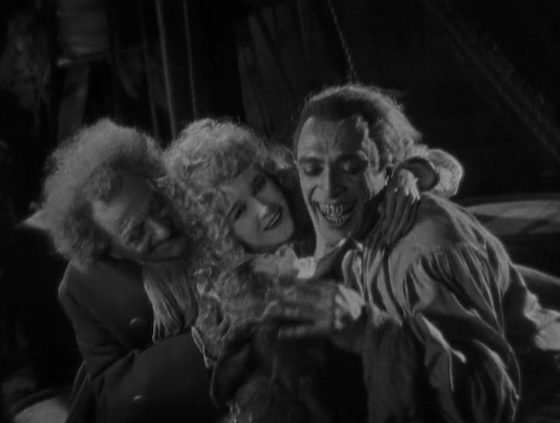
Conrad Veidt delivers one of silent cinema's truly astonishing performances. The grin is the first thing you notice because, frankly, how could it not be? It's grotesque, unsettling, and permanently burned into your memory. But after a while something remarkable happens. You stop seeing the smile. Instead, you start watching his eyes. Veidt somehow communicates fear, shame, joy, tenderness, humiliation, and hope while wearing a face incapable of expressing any of those emotions. It's a masterclass in physical acting. If Lon Chaney earned the title "The Man of a Thousand Faces," Veidt proved you could tell a thousand emotions with only one.
Director Paul Leni continues to establish himself as one of Universal's earliest visual geniuses. Every frame feels meticulously composed, blending German Expressionism with storybook fantasy in ways that remain breathtaking nearly one hundred years later. Towering castles, twisting staircases, heavy shadows, and dense fog transform England into a waking nightmare. Modern filmmakers spend fortunes trying to create immersive worlds with computer-generated imagery. Leni did it with lighting, architecture, and pure imagination.
Thematically, this may be Universal's darkest silent film to this point. Quasimodo was rejected because of his appearance. Erik hid beneath a mask because society couldn't bear to look at him. Gwynplaine has no such luxury. His face is his prison, forcing him to smile through every humiliation life throws at him. The true horror isn't the disfigurement. It's watching an entire society define a man's worth by the first thing they see. That's a theme that has never stopped being relevant.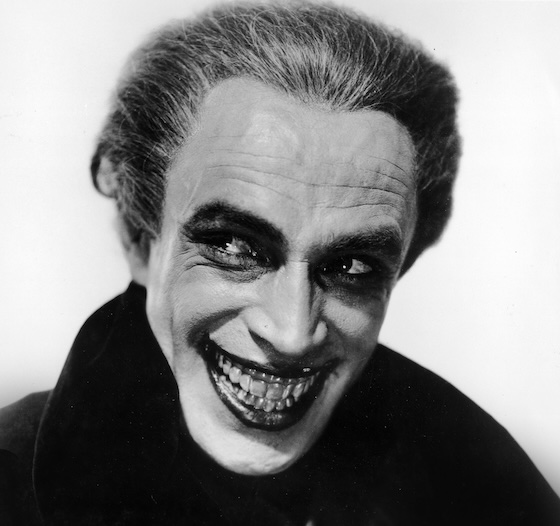
And yes...let's talk Batman.
Watch Gwynplaine enter a room. Watch the frozen grin. Watch the mixture of elegance, tragedy, theatricality, and madness. Then tell me you don't see the DNA of every cinematic Joker that followed. From Cesar Romero's painted grin to Jack Nicholson's theatrical crime boss, Heath Ledger's scarred anarchist, and Joaquin Phoenix's broken outcast, pieces of Gwynplaine are scattered throughout them all. Comic book fans love tracing influences, but this isn't simply influence. This is the blueprint. Without The Man Who Laughs, Batman's greatest enemy probably looks very different.
Viewed alongside The Hunchback of Notre Dame, The Phantom of the Opera, and The Cat and the Canary, another realization begins to emerge. Universal wasn't simply making horror films during the silent era. They were building an entire philosophy around what made monsters memorable. None of these characters are frightening because they're evil. They're frightening because they're lonely. They're isolated. They're misunderstood. They force us to confront our own cruelty far more than they ask us to fear theirs. That's why these films still resonate after nearly a century. The monsters were never really the problem.
We were.


Universal Horror: Monsters And Curiosities Blu-ray - Umbrella Entertainment Exclusive / Collector's Edition
Home Video Distributor: Umbrella Entertainment
Available on Blu-ray - July 1, 2026
Screen Formats: 1.33:1; Various
Subtitles: English SDH
Video: 1080p
Audio: DTS-HD Master Audio 2.0
Discs: Blu-ray Disc; nineteen-disc set
Region Encoding: Locked to Region A
As the fourth film in Umbrella Entertainment's Universal Horror: Monsters and Curiosities collection, The Man Who Laughs stands as one of the crown jewels of silent cinema.
Conrad Veidt's extraordinary performance, Paul Leni's breathtaking direction, and Victor Hugo's timeless themes combine to create a film that feels remarkably contemporary despite its age. It remains one of Universal's most emotionally devastating achievements and one of the most influential films ever made, whether you're a horror fan, a silent film devotee, or someone who has ever smiled every time Batman squared off against the Joker.
Sometimes the most unforgettable monsters aren't the ones trying to scare us. They're the ones trying desperately to be seen.
Video
Umbrella Entertainment presents The Man Who Laughs with another gorgeous high-definition restoration that allows Paul Leni's extraordinary visual style to flourish.
Contrast is beautifully balanced, shadow detail is exceptional, and the organic film grain gives the presentation a wonderfully cinematic texture. Most impressive is the clarity of Conrad Veidt's legendary makeup, whose horrifying grin reveals astonishing detail while allowing every subtle movement of his eyes to carry the emotional weight of the performance.
It's one of the visual standouts of the entire collection.
Audio
The lossless orchestral accompaniment perfectly supports the film's shifting emotional landscape, moving effortlessly between gothic spectacle, heartbreaking romance, political intrigue, and moments of genuine suspense.
The music never overwhelms the imagery, instead enhancing Veidt's remarkable physical performance with warmth, depth, and dramatic energy. Like the other silent presentations in Umbrella's collection, the audio presentation is clean, immersive, and exactly what a film of this stature deserves.
Supplements:
Commentary:
- None
Special Features:
The lossless orchestral accompaniment perfectly supports the film's shifting emotional landscape, moving effortlessly between gothic spectacle, heartbreaking romance, political intrigue, and moments of genuine suspense. The music never overwhelms the imagery, instead enhancing Veidt's remarkable physical performance with warmth, depth, and dramatic energy. Like the other silent presentations in Umbrella's collection, the audio presentation is clean, immersive, and exactly what a film of this stature deserves.

| Movie |  |
|
| Video |  |
|
| Audio | |
|
| Extras |  |
|
|
Composite Blu-ray Grade
|
||












![Trick or Treat (1986) – 4K Ultra HD [Standard Edition]](/images/resized/images/stories/2026/trick-or-treat-4k_40_40.jpg "Trick or Treat (1986) – 4K Ultra HD [Standard Edition]")