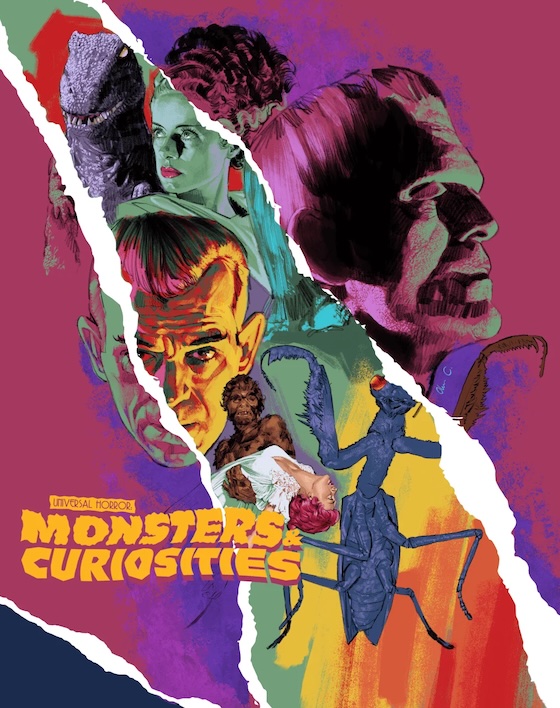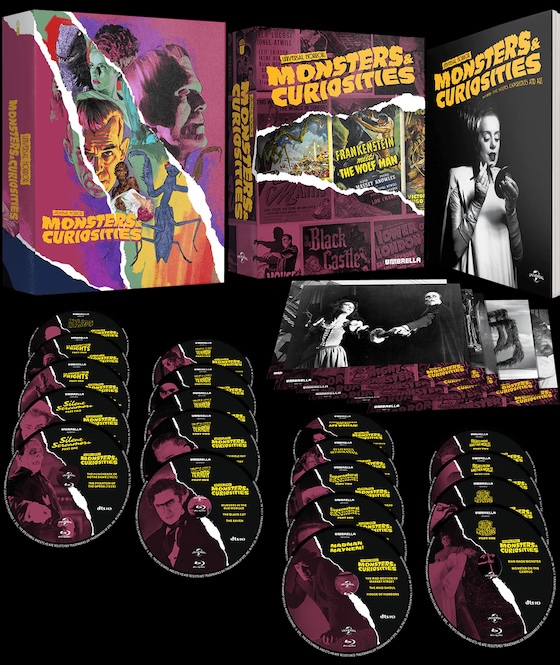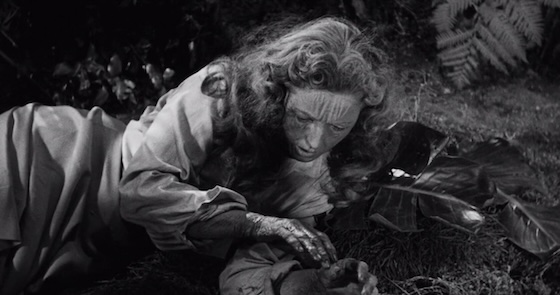
Let's begin with the obvious: Dr. Paul Talbot is an asshole. Not misunderstood, not complicated, not secretly wounded beneath a rough exterior. An asshole. He drinks too much, treats his wife June like something unpleasant he accidentally stepped in, openly resents the fact that she's gotten older, and spends enough time reminding her of it that you begin wondering why The Leech Woman expects us to worry about supernatural horror when marriage to this prick already seems terrifying enough. Watching the film in 2026 as part of Umbrella Entertainment's Universal Horror: Monsters and Curiosities (1923–1960) collection changes its temperature considerably. In 1960, audiences were supposed to recoil from a woman so desperate to remain young that she's willing to kill for it. Sixty-six years later, I'm watching Coleen Gray's June Talbot thinking: Lady, I understand how you got here. Maybe stop murdering people, sure, but Paul? Drain that motherfucker first.
June is trapped inside a marriage that has curdled into mutual misery when an impossibly old woman named Malla (Estelle Hemsley) arrives with an extraordinary claim. She possesses knowledge of a secret African method capable of restoring youth. Paul (Phillip Terry), being an endocrinologist and therefore apparently legally obligated to become excited whenever somebody mentions glands, immediately wants proof. Soon Paul and June are traveling to Africa, where they witness Malla transform into a younger woman through a ritual involving orchid pollen and a secretion taken from the pineal gland of a man. Science has officially left the building. We're in Universal territory now. June undergoes the ritual herself and emerges young and beautiful again, which would be terrific news except the transformation doesn't last. There's also the minor inconvenience that maintaining it requires killing men. We've all had beauty routines that got out of hand.
What makes The Leech Woman considerably more interesting than its title suggests is that June doesn't begin as some vain monster terrified of crow's feet. She's a woman whose self-worth has been systematically dismantled. Paul has convinced her that aging has made her undesirable, and the movie spends enough time establishing his cruelty that June's decision to undergo the rejuvenation procedure feels less like narcissism than desperation. When Coleen Gray transforms into her younger self, she doesn't simply look different. Her entire physical presence changes. Her posture straightens, her confidence returns, men notice her again—and June notices them noticing. That's the drug. The supernatural treatment doesn't merely restore her face. It restores the power she has been told she lost.
Coleen Gray is the entire damn movie, and she gives June far more emotional complexity than this sort of late-period Universal programmer necessarily required. The older June is bitter, exhausted, alcoholic, and humiliated. The rejuvenated June is playful, sexual, confident, and increasingly ruthless. Yet Gray never makes them feel like separate characters because the desperation remains underneath both versions. Every time the effect begins wearing off, the panic returns because June isn't simply becoming old again. She's becoming invisible. That's where The Leech Woman gets unexpectedly nasty. The movie is ostensibly warning us about vanity, but it's also demonstrating exactly why June is afraid of aging. Everyone treats her better when she's young. Men desire her. Rooms open to her. Possibilities return. The film condemns June for becoming addicted to youth while simultaneously constructing a world that rewards her every time she achieves it. That's one hell of a mixed message, and I suspect it's why the movie remains interesting.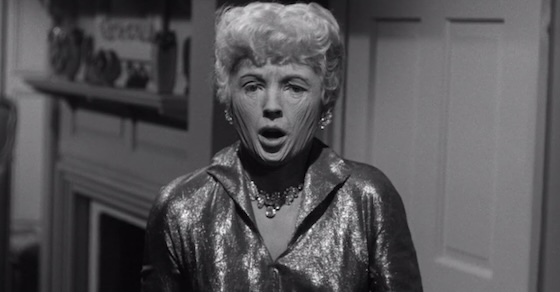
Of course, this is still a Universal horror picture called The Leech Woman, so eventually the thematic material has to make room for murder. June returns to America armed with the knowledge necessary to rejuvenate herself and begins selecting men whose pineal glands can keep the wrinkles away. She assumes a new identity, becomes involved with attorney Neil Foster (Grant Williams), and runs headfirst into his fiancée Sally (Gloria Talbott), which complicates matters considerably. The rejuvenation sequences become increasingly desperate as June realizes she's trapped inside a cycle with no possible happy ending. Youth fades, another man is needed, youth fades again. Feed, transform, repeat. There's almost something vampiric about it. Dracula needs blood. June needs glandular fluid. Both consume other people to preserve an unnatural existence. But Dracula rarely hates himself for doing it.
June does.
Director Edward Dein—yes, the same Edward Dein who just gave us the vampire Western Curse of the Undead—doesn't have a huge budget, but he understands that the horror works best when focused on June rather than the mechanics of the ritual. The transformation makeup is effective precisely because it's cruel. June doesn't simply return to her natural age when the treatment wears off; the process eventually pushes her beyond it, turning the promise of youth into grotesque accelerated decay. The makeup effects give the later stages real punch, but Gray sells them because we understand exactly what seeing that reflection means to June.
The African sequences are another matter. Yeah, it's 1960. You know where this is going. The film's presentation of Africa and the Nando tribe is loaded with the exoticized Hollywood stereotypes of its era: secret rituals, drums, mysterious tribal knowledge, white outsiders wandering into a culture whose primary narrative purpose is providing supernatural wisdom. There's no point pretending that material hasn't aged badly. It has. But Malla is also allowed an interesting degree of authority. She knows exactly what Paul wants before he understands it himself, recognizes June's suffering, and ultimately provides the knowledge that destroys the people foolish enough to believe they can take it home and control it. Paul thinks he's studying Malla. Malla is studying Paul, and guess who's smarter.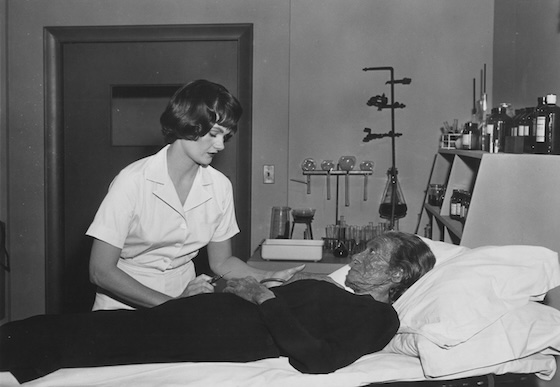
The title is also fascinating because calling June The Leech Woman places all the moral judgment squarely on her. Yes, she kills men to maintain her youth. That's pretty fucking leech-like. But the entire movie is filled with people feeding on one another. Paul feeds on June's insecurity. Men feed on young women's beauty. June eventually feeds literally upon men. Everybody wants something from somebody else's body. June is simply the one who makes the metaphor bloody.
By the time the movie reaches its inevitable conclusion, there's nowhere left for her to go. She can't stop aging. She can't continue killing forever. She can't return to the woman she was because that woman has already been convinced she isn't worth returning to. That's bleak, especially for a movie whose poster basically promises a lady sucking youth out of dudes.
And because The Leech Woman arrived in 1960, there's something appropriately melancholy about watching it this deep into Umbrella's collection. We're reaching the endpoint of the chronology promised by Universal Horror: Monsters and Curiosities (1923–1960). We began with Lon Chaney's Quasimodo in The Hunchback of Notre Dame, a man treated like a monster because of his appearance. Nearly four decades later, here is June Talbot destroying herself because of hers.
That's quite a fucking circle.


Universal Horror: Monsters And Curiosities Blu-ray - Umbrella Entertainment Exclusive / Collector's Edition
Home Video Distributor: Umbrella Entertainment
Available on Blu-ray - July 1, 2026
Screen Formats: 1.33:1; Various
Subtitles: English SDH
Video: 1080p
Audio: DTS-HD Master Audio 2.0
Discs: Blu-ray Disc; nineteen-disc set
Region Encoding: Locked to Region A
The Leech Woman is better than its reputation and much more interesting than its wonderfully trashy title suggests. Coleen Gray gives the movie a wounded center that transforms what could have been another disposable rejuvenation story into something sadder, angrier, and occasionally uncomfortable. June Talbot does monstrous things, but the movie never completely allows us to forget the cruelty that pushed her toward them. And Phillip Terry deserves credit because Paul Talbot might be one of the most efficiently hateable husbands in Universal Horror. Within minutes I was ready to help June find the pineal gland myself.
The cultural material has aged poorly, the science is complete horseshit, and some of the melodrama gets wonderfully thick. None of that kills the movie. If anything, the rough edges make it more fascinating. The Leech Woman isn't really about eternal youth. It's about what happens when someone becomes convinced that getting older means becoming worthless.
The horror isn't that June believes it. It's how many people around her taught her to.
Video
Umbrella Entertainment's high-definition presentation gives The Leech Woman a pleasingly filmic appearance, with the black-and-white photography retaining strong contrast and natural grain. The most important element is facial detail because this is a movie obsessed with faces—young faces, aging faces, desirable faces, faces suddenly confronted by mortality.
The makeup work benefits from the added clarity without becoming completely betrayed by it, and the later transformations retain their grotesque impact. Interiors are cleanly resolved, while the African sequences and nighttime material maintain enough shadow detail to preserve atmosphere.
Audio
The mono presentation keeps dialogue clean and stable, which is particularly important because much of the film's real violence happens verbally before anyone starts extracting glandular secretions. Coleen Gray and Phillip Terry's poisonous exchanges land clearly, while the ritual sequences, score, and later suspense material retain appropriate presence. Nothing needs to shake the room. This is intimate horror built around faces, voices, and increasingly terrible decisions.
Supplements:
Within Umbrella Entertainment's Universal Horror: Monsters and Curiosities (1923–1960) collection, The Leech Woman feels like an unexpectedly appropriate endpoint for this particular late-period run. The traditional monsters have disappeared, but Universal's old obsessions remain: transformation, forbidden knowledge, mortality, outsiders, science colliding with superstition, and human beings convinced they can somehow cheat death without reading the fine print.
Frankenstein built a body. Dracula preserved himself with blood. The Invisible Man erased his own flesh. June Talbot just wants her face back. After nearly forty years of Universal monsters desperately trying to become human, The Leech Woman gives us a human being so terrified of what she sees in the mirror that she becomes the monster instead.
That's not a bad place for 1960 to leave us.

| Movie |  |
|
| Video |  |
|
| Audio | |
|
| Extras |  |
|
|
Composite Blu-ray Grade
|
||