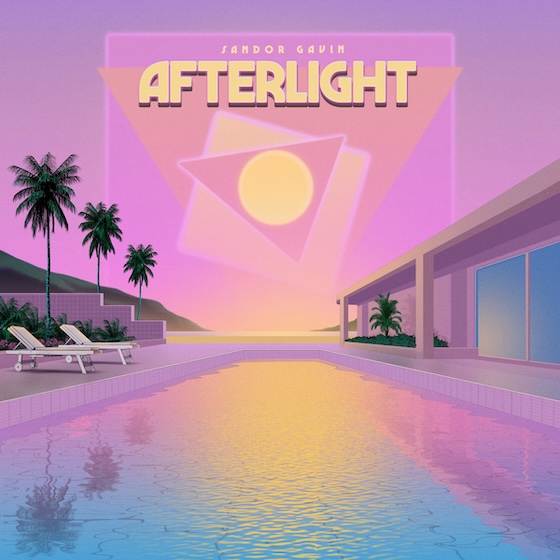
Dear Lord of the Neon Sax, this album doesn’t just play—it materializes like the moment the buzz hits and the saxophone melts into the synths, that slippery, honey‑warm glide that makes the whole room feel like it’s breathing with you. It’s 11 p.m., you’re two drinks past caring about gravity, and suddenly, Afterlight slides up beside you like a neon‑soaked stranger with a sax slung over their shoulder, exhaling a note so smooth it rewires your bloodstream. The colors get louder, the air gets softer, and every bassline feels like it’s leaning in to whisper a secret. You’re not just listening—you’re drifting, swaying, letting Sandor Gavin crack open a wormhole behind your eyelids while that sax curls around your spine like a warm, analog serpent.
Afterlight, by Sandor Gavin—the synthpop/synthwave multi‑instrumentalist whose work drifts between dreamy nostalgia and neon‑lit emotional clarity—rises from the digital ether like a neon ghost stretching after a long sleep, flickering into focus inside a chrome‑lined bar at the edge of the afterlife. This is synthwave as séance, a resurrection ritual for moods you thought you’d forgotten. Gavin isn’t assembling tracks so much as stitching together a retro‑future dreamscape where every collaborator is another spectral wanderer drifting through ultraviolet fog. It’s the culmination of years spent crafting lush, emotionally resonant soundscapes—echoes of Fiction Theory, Definitive Motion, and Echoes—now sharpened into something cinematic and otherworldly.
“Purple Shades” kicks the door open like a convertible sliding into frame during a midnight shoot. It’s pure chrome‑sunset energy—synths blooming like neon flowers, basslines pulsing like the heartbeat of a city that never existed. Then Tyconic shows up on “Heatwave,” and suddenly you’re sweating under ultraviolet streetlamps, drifting through a retrofuturist Miami where the humidity is 90% nostalgia and 10% danger. The track feels like a heat mirage that learned to dance, shimmering just out of reach, daring you to chase it deeper into the night.
By the time Sheaf splashes into—well—“Splash,” the album has fully entered its aquatic cyberdream phase. Everything is liquid circuitry, shimmering pads, and the sense that you’re floating through a digital ocean rendered on a 16‑bit graphics card. Then Sleepless‑Nights and Nathan Madsen pull you onto “The Veranda,” a track that feels like sipping a neon cocktail on the balcony of a luxury hotel in the afterlife, watching spectral traffic drift by. It’s smooth, romantic, and just a little haunted—the synthwave equivalent of leaning on a railing and realizing you’re already a ghost. It’s also a perfect nod to Gavin’s long‑running collaborative constellation, including his work with Luxe & Leisure and Horizons 1982, who help define this album’s emotional gravity.
From there, the album deepens into its nocturnal glow. Gavin’s production becomes a kind of neon cartography, mapping out emotional terrain with laser precision. Pads swell like rising holograms; basslines throb like the pulse of a city dreaming in electric blue. Every transition feels like stepping through another doorway in a retrofuturist labyrinth, each room lit by a different shade of longing.
The title track—“Afterlight,” with Horizons 1982—is where the album stops being a vibe and becomes a signal. The synths shimmer like cosmic dust drifting across a CRT screen; the melody feels like a message encoded in starlight. It’s the sound of a civilization sending its final postcard before dissolving into the void. And then Tommy II drags you “Into the Blue,” a high‑speed chase across an ocean made of neon glass—all momentum, all glow, all adrenaline.
As the album winds down, Luxe & Leisure glide in with “Lumenfall,” a soft‑focus dream rendered in ultraviolet pastels, and Jacket. closes the door behind you with “Dissipate,” a sigh of fading color that lingers like the afterimage of a memory you’re not entirely sure you lived. Even “Fireside,” tucked in the middle, feels like a warm glitch in the matrix—a moment of analog comfort in a digital afterworld.
Afterlight feels less like an album and more like a night you barely remember but can’t stop feeling—a fever dream of chrome skylines, spectral lovers, and neon cocktails that taste like longing. It’s synthwave at its most cinematic, its most collaborative, its most alive. And when the last note fades, you’re left blinking in the glow, wondering whether you’ve just returned from the afterlife or accidentally left a piece of yourself there.
By the time Afterlight flickers out, the whole album feels like a transmission from some ultraviolet oracle, a place where memory and circuitry blur into one long electric sigh—and all you can think is more neon, more fever dream, more retro‑cosmic prophecy. Those early tracks—“Purple Shades,” “Heatwave,” “Splash,” and “The Veranda”—echo through the final glow like neon runes scrawled across the sky by a dying star, each one a reminder that Gavin and his spectral collaborators aren’t just making music; they’re divining futures. When the last synth dissolves into the electric dark, you’re left hovering between worlds, neon cocktail in hand, watching a city made of light and longing pulse beneath you—a beacon, a warning, a promise that the night is still unfolding, and the afterlife is only getting brighter.
Afterlight can be purchased here: Afterlight | Sandor Gavin