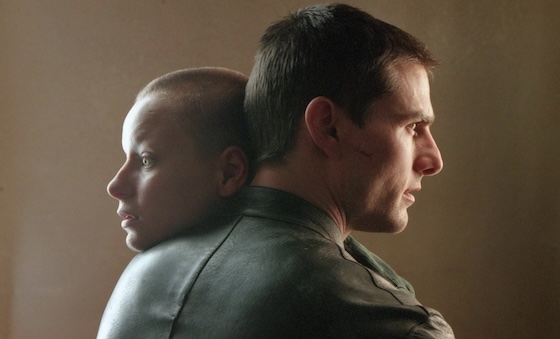
Before Silicon Valley discovered that the future could be mined, sold, and optimized, Steven Spielberg made Minority Report, a film that now plays less like speculative fiction and more like an uncomfortably accurate documentary about where power actually lives.
Released in 2002, the film arrived as a response to 9/11 anxiety, preemptive warfare, and the seduction of safety over liberty. But in 2025, Minority Report has mutated into something far more frightening: not a warning, but a prototype.
This is no longer a story about “what if we could see crime before it happens.” It is about what happens when systems stop asking why and begin enforcing when.
Spielberg’s future — retina-scanning billboards that greet you by name, gesture-based interfaces, frictionless biometric surveillance — is not just prescient. It is now banal. The true horror is not that the film predicted these technologies, but that we accepted them without ever questioning the moral infrastructure beneath them.
Tom Cruise’s John Anderton is not a hero anymore. He is a man whose entire identity is built on trusting an algorithm. His collapse is not tragic — it is inevitable. He does not fall because the system fails; he falls because the system works exactly as designed. Precrime is not justice — it is liability management.
And that is the film’s secret achievement: Minority Report isn’t about crime prevention. It is about the transformation of morality into math.
Janusz Kamiński’s cinematography, once criticized for its blown-out whites and bleached blues, now reads as intentional pathology — a world permanently overexposed, where privacy has been erased at the molecular level. His camera jitters, lunges, and fractures the frame like a surveillance drone that can’t quite decide whether it is observing or hunting. This is not futurism. It is behavioral architecture.
John Williams’ score, one of his most underrated, rejects the heroic bombast of his blockbuster canon and instead builds a cathedral of dread — operatic, fatalistic, almost liturgical. It sounds less like a chase and more like a verdict.
But the film’s deepest wound remains its ending.
In a post-Cambridge Analytica, post-AI sentencing algorithm, post-predictive-policing America, Spielberg’s insistence on redemption feels not just soft — it feels dishonest. The dismantling of Precrime is treated as closure, as though power ever dismantles itself. The system collapses too cleanly. The world exhales too easily.
The ending should not have been freedom.It should have been entrenchment.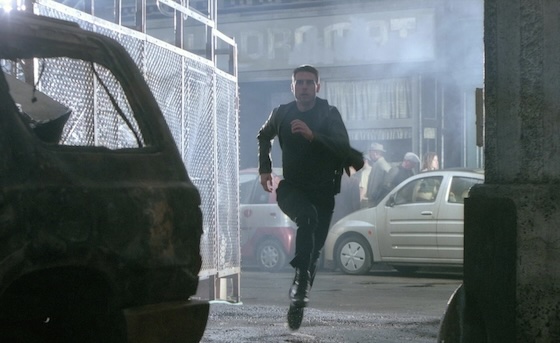
Imagine if Anderton had been killed — not because the Precogs were wrong, but because society needed them to be right. Imagine if Burgess wasn’t exposed, but absorbed. Imagine a world where the minority report becomes an error margin rather than a moral rupture.
That is the ending we are living in.
Because in 2025, we no longer ask whether prediction should replace judgment. We ask how efficiently it can do so. We are not preventing crime — we are pre-authorizing punishment. Credit scores, social graphs, risk profiling, behavioral modeling — we are all already standing in line for our halo spiders.
Despite its compromised final act, Minority Report endures as Spielberg’s most unsettling work because it accidentally escaped the genre that birthed it. It is not science fiction anymore.
It is infrastructure.
And the most chilling realization is this: The future Spielberg feared did not need psychic children floating in milk baths. It only needed us to believe that certainty was safer than freedom.
Which brings us to the new Minority Report Steelbook, a gorgeous slab of late-stage capitalism irony. The transfer is pristine, the blues are bluer, the future has never looked cleaner — perfect for a movie about how technology ruins everything it touches. It’s the kind of premium collectible that makes you feel special while reminding you that you are absolutely being tracked for buying it. Pretty packaging for the end of free will: very on-brand.

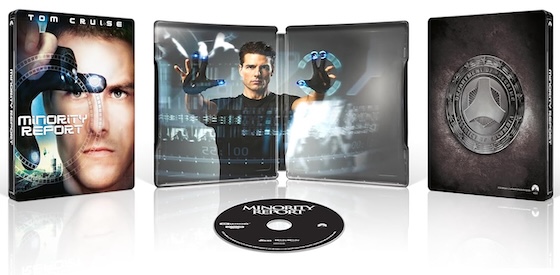

 4K Ultra HD + Digital HD / SteelBook / Limited Edition
Home Video Distributor: Paramount
Available on Blu-ray - December 9, 2025
Screen Formats: 2.39:1
Subtitles: English; English SDH; French; Spanish
Video: Dolby Vision; HDR10
Audio: English: DTS-HD Master Audio 5.1; French: Dolby Digital 5.1; Spanish: Dolby Digital 2.0
Discs: 4K Ultra HD; Blu-ray Disc; Two-disc set
Region Encoding: 4K region-free; blu-ray locked to Region A
In a future where crime is eliminated before it happens, justice has become a matter of prediction.
Set in 2054, Steven Spielberg’s Minority Report follows elite Precrime detective John Anderton (Tom Cruise) as he hunts killers before they strike — until the system he trusts marks him as its next target. Framed for a murder he hasn’t yet committed, Anderton is forced into hiding, uncovering a terrifying truth behind the technology that promises perfect safety.
Blending white-knuckle action with noir mystery, Spielberg crafts a world of retinal scanners, targeted advertising, and algorithmic justice that feels more real today than ever. With visionary cinematography by Janusz Kamiński and a haunting score from John Williams, Minority Report is a prophetic thriller about free will, surveillance, and what happens when certainty replaces conscience.
Experience this modern sci-fi classic in stunning Steelbook presentation — because in a world that sees everything, no one is truly innocent.
VIDEO
The new 4K transfer finally does justice to Minority Report’s famously contentious visual design. Janusz Kamiński’s high-contrast, bleach-bypassed cinematography — once derided on early home video as muddy, blown-out, or “broken” — now reveals its intentional texture: inky blacks hold detail, the film’s icy blues no longer crush into noise, and the shimmering whites retain structure instead of smearing into glare.
Grain is present but filmic, not scrubbed into plastic, giving the image a tactile density that reminds you this was shot on real stock, not born inside a server farm. It’s the first time the movie’s diseased future feels crisp rather than compromised, proving that what once looked like a mastering problem was always a stylistic warning.
AUDIO
The audio upgrade is just as revelatory. The new immersive mix finally lets John Williams’ ominous, operatic score breathe, spreading its low choral dread and percussive surges across the soundfield with cathedral-like scale, while the film’s hyper-detailed effects design — the whisper of retinal scanners, the metallic chatter of halo spiders, the vertiginous roar of mag-lev traffic — now moves with predatory precision around the room. Dialogue is clean and anchored, even in the film’s densest sonic assaults, making the entire track feel less like a remaster and more like the movie finally speaking at full volume after two decades of being politely muted.
Supplements:
Commentary:
-
The included audio commentary is less a nostalgia lap and more a film-school masterclass. Spielberg digs into how Minority Report was his first real experiment with world-building through systems rather than spectacle — designing not just sets, but entire bureaucratic behaviors: how police move when they no longer arrest the present, how advertising behaves when it recognizes you, how fear reshapes architecture. He admits the film was built from anxiety, not optimism, calling it his “post-9/11 paranoia picture,” and you can hear the unease still lingering in his voice.
Janusz Kamiński joins in to defend the bleach-bypass look that nearly broke projectionists in 2002, explaining how the blown highlights and crushed shadows were meant to feel like corrupted data rather than photography. It’s a rare moment of a cinematographer openly acknowledging that the movie was supposed to look “wrong.” The track also dives into the early gesture-control tech demos — including how MIT researchers were consulted years before the iPhone existed — making the film feel less prophetic accident and more R&D lab in disguise.
Most telling is Spielberg’s unease with the ending. He doesn’t quite apologize for it, but he circles it like a man who knows he flinched. He calls it “necessary hope,” which, two decades later, plays like a euphemism for creative surrender. The commentary doesn’t rewrite the movie, but it quietly reframes it as a director wrestling with how dark he was actually willing to let a summer blockbuster become — and losing that fight just enough to keep the lights on.
Special Features:
The special features round out the Steelbook as more than just shelf candy, transforming it into a dense archive of early-2000s futurism that accidentally doubles as a historical record of how close we already were to the world the film warned us about. Instead of the usual fluff, these extras lean hard into the tech, the psychology, and the paranoia — less “making of a movie,” more “autopsy of a future that escaped containment.”
Special Features Include:
- The Making of Minority Report – a feature-length behind-the-scenes documentary charting the film’s evolution from Philip K. Dick’s story to Spielberg’s surveillance-state nightmare
- Future Realized – scientists, ethicists, and technologists discuss how the film’s concepts now exist in the real world
- Precrime Tech Lab – deep dives into gesture-based interfaces, retinal scanning, and predictive modeling
- Production Design: Building 2054 – a visual exploration of the film’s architecture, advertising culture, and vehicle concepts
- Halo Spiders Unleashed – a breakdown of the film’s most disturbing sequence and how it was engineered to feel invasive
- Storyboards & Concept Art Galleries – hundreds of images mapping the film’s visual grammar
- Theatrical Trailers & TV Spots – a time capsule of how the future was sold before it actually arrived

| Movie |  |
|
| Video |  |
|
| Audio | |
|
| Extras | |
|
|
Composite Blu-ray Grade
|
||











![Trick or Treat (1986) – 4K Ultra HD [Standard Edition]](/images/resized/images/stories/2026/trick-or-treat-4k_40_40.jpg "Trick or Treat (1986) – 4K Ultra HD [Standard Edition]")