As the opening film in Steven Spielberg: The Spotlight Collection, Jaws feels less like the first chapter of a career retrospective and more like a detonation. Before the aliens, before the dinosaurs, before the archaeologists and dreamers and lost boys, there was this: a young director barely in his late twenties staring down an impossible production and somehow emerging with a film that changed Hollywood forever.
It is fitting that this collection begins here, because everything Steven Spielberg would become is already present in Jaws: the awe, the terror, the flawed but deeply human heroes, the impeccable sense of pacing, and an almost supernatural ability to make audiences feel wonder and dread in equal measure.
But history is only part of the story. Jaws is something else entirely. There are movies you admire. Movies you revisit. Movies you respect. And then there is Jaws.
Jaws doesn't ask permission. It doesn't politely introduce itself as one of the greatest films ever made. It grabs you by the ankle, drags you screaming into deep water, and reminds you that fear isn't rational. Fear is primal.
Fifty years later, it still works.
The shark may be the monster, but Spielberg understands that terror starts long before teeth hit flesh. It lives in empty water. In a mother's scream. In Sheriff Martin Brody staring at the ocean, realizing he's responsible for everyone standing on that beach and powerless to stop what is coming.
That sheriff is magnificently played by Roy Scheider. A city cop trapped on an island, afraid of the water and slowly drowning beneath political pressure. Every instinct tells him to close the beaches after the mutilated remains of a young woman wash ashore, but Amity runs on summer dollars, and Mayor Vaughn would rather gamble with lives than lose tourist revenue.
So Brody compromises. People die. And Jaws never lets him forget it.
What follows is one of the greatest pivots in cinema history. The film abandons the crowded beaches and becomes something leaner, meaner, and infinitely more dangerous: three men, one boat, and a fish with the temperament of a serial killer.
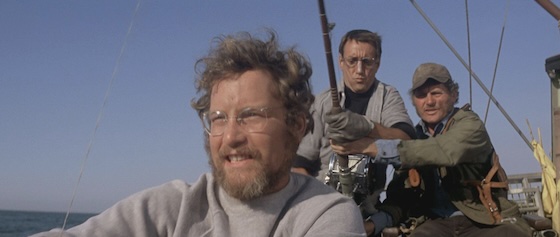
Robert Shaw's Quint is pure cinematic nitroglycerin. Weathered, obsessive, funny, cruel, and half-crazy, he dominates every scene he enters. Richard Dreyfuss's Hooper is his perfect opposite—young, educated, arrogant enough to challenge Quint, and smart enough to know exactly how screwed they all are.
The arguments. The drinking. The scars. The Indianapolis speech. Good Lord, the Indianapolis speech. It's one of the greatest monologues ever put on film—not because it's performed, but because it's confessed. Shaw doesn't act that scene. He bleeds it. He speaks as a man who has stared into oblivion and never escaped it, no matter how many sharks he's hunted since.
And then Spielberg does the impossible: he makes a malfunctioning rubber shark into one of the most terrifying monsters in cinematic history.
The shark barely worked. Production was chaos. The ocean fought them every day. So Spielberg adapted. He hid the beast beneath the waves and weaponized anticipation itself. A fin cutting through water. Yellow barrels bobbing on the horizon. John Williams' two-note death march creeping closer.
Da-dum.
Da-dum.
Cinema has been chasing that feeling ever since.
Thousands of creature features have tried to replicate Jaws. Most misunderstand the assignment. Bigger monsters aren't scarier. More effects aren't more suspense. Spielberg understood that the audience's imagination is a far crueler special effect than anything Hollywood can manufacture.
And that's why Jaws endures. Not because of nostalgia. Not because it invented the summer blockbuster. Not because it changed Hollywood forever. It endures because somewhere inside every one of us is an ancient fear of what lurks below the surface—and Jaws taps directly into that fear with surgical precision.
Watching it again in glorious 4K as part of Steven Spielberg: The Spotlight Collection is a reminder not only of how extraordinary Spielberg's career would become, but of the impossible standard he set for himself right out of the gate. The image is stunning, the tension remains unbearable, and the film has lost none of its bite.
I've watched Jaws more times than I can count. I know every line. Every cut. Every musical cue. And every single time Brody backs into that tower after seeing the shark for the first time, I grin like a lunatic when he mutters:
"You're gonna need a bigger boat."
Yeah. We all were. Jaws remains an absolute masterpiece. The water has never been safe since 1975.



 Steven Spielberg: The Spotlight Collection – Jaws (1975) 4K UHD Steelbook
Home Video Distributor: Universal Pictures
Available on Blu-ray - June 9, 2026
Screen Formats: 2.39:1
Subtitles: English SDH; French; Spanish
Video: Native 4K; Dolby Vision; HDR10+
Audio: Dolby Atmos; Dolby TrueHD 7.1; DTS 2.0 Mono
Discs: 4K Ultra HD; Blu-ray Disc; Twenty-disc set
Region Encoding: 4K region-free; blu-ray locked to Region A
Steven Spielberg: The Spotlight Collection is more than a box set—it's a cinematic time capsule charting the evolution of one of the greatest storytellers in film history. Beginning with Jaws is not only appropriate; it's essential. This is the film that announced Spielberg to the world with a roar, the moment his gift for suspense, character, spectacle, and raw emotional storytelling first exploded onto the screen. Long before he transported audiences to worlds inhabited by aliens, adventurers, and dinosaurs, Spielberg taught us to fear the ocean itself. Viewed within The Spotlight Collection, Jaws isn't merely the first film in the lineup; it's the spark that ignited a career that would reshape modern cinema and forever alter what audiences expected from a trip to the movies.
VIDEO
Spielberg's seaside nightmare has never looked more alive—or more ominous. The grain structure remains beautifully filmic, preserving the texture and warmth of the original 35mm photography while revealing astonishing new detail in sun-drenched beaches, weathered faces, and the endless blue expanse of the Atlantic.
Blacks are deeper, contrast is richer, and the HDR grading gives the ocean an almost predatory presence of its own, shifting from inviting turquoise shallows to dark, unknowable depths with breathtaking subtlety. Most impressive is how restrained the restoration feels; this isn't Jaws polished into something modern, but Jaws restored to the vivid, terrifying experience audiences felt in 1975.
Paired with the immersive audio mix and John Williams' iconic score, the 4K edition doesn't simply improve the film—it reminds you why it remains one of the most electrifying movie experiences ever committed to celluloid.
AUDIO
The audio presentation of Jaws is every bit as impressive as the visual restoration. John Williams' legendary score has always been the film's secret weapon, but in this mix it feels startlingly alive, with those infamous two notes carrying an even greater sense of dread and menace.
Dialogue remains crisp and natural throughout, allowing every exchange between Brody, Hooper, and Quint to shine—from the humor of their cabin banter to the haunting power of Quint's USS Indianapolis monologue. Ambient effects are equally immersive: crashing waves, creaking wood, the groan of the Orca under strain, and the violent thrashing of the shark create a soundscape that pulls you into the middle of the hunt.
Importantly, the mix never overwhelms the film's original character. Instead, it enhances Spielberg's carefully crafted suspense, proving once again that in Jaws, what you hear can be every bit as terrifying as what you see.
Supplements:
Commentary:
- None
Special Features:
Universal has packed Jaws with a treasure trove of special features, making its inclusion in Steven Spielberg: The Spotlight Collection feel like a celebration rather than a simple reissue. The crown jewel is undoubtedly "Jaws @ 50: The Definitive Inside Story," an engrossing feature-length documentary that explores the film's turbulent production, enduring legacy, and surprising impact on shark conservation through interviews with Spielberg, filmmakers, cast members, and marine experts. The beloved "The Making of Jaws" remains essential viewing, chronicling the infamous production woes with remarkable candor, while "The Shark Is Still Working: The Impact & Legacy of Jaws" examines the film's cultural footprint decades after its release. Add in "Jaws: The Restoration," deleted scenes and outtakes, vintage featurettes like "From the Set," plus storyboards, production photographs, and marketing materials, and what emerges is a fascinating archival deep dive into one of cinema's most influential films. For longtime fans, these extras are more than bonus content—they are a front-row seat to the chaos, ingenuity, and sheer determination that transformed a nightmare production into a cinematic legend.
- Jaws @ 50: The Definitive Inside Story (Feature-Length Documentary)
- The Making of Jaws (Original, award-winning documentary)
- The Shark Is Still Working: The Impact & Legacy of Jaws
- Jaws: The Restoration (A look at the film's meticulous restoration process)
- Deleted Scenes and Outtakes
- From the Set (Vintage behind-the-scenes featurette)
- Theatrical Trailer
- Storyboards
- Production Photographs
- Marketing Archives and Promotional Materials
- Cast and Crew Interviews
- Archival Footage from the Production

| Movie |  |
|
| Video |  |
|
| Audio | |
|
| Extras | |
|
|
Composite Blu-ray Grade
|
||