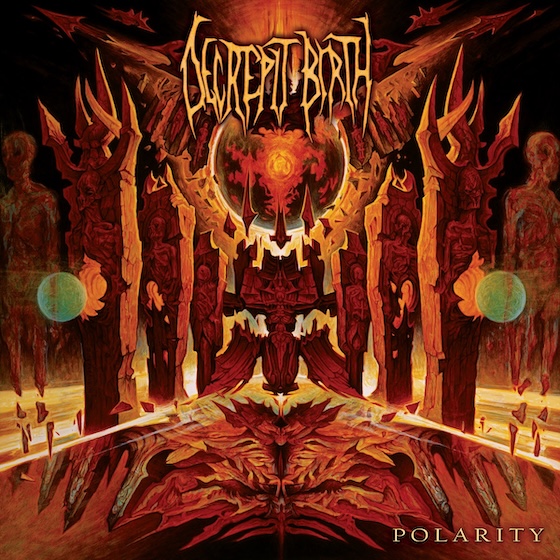
There’s a certain kind of record that doesn’t just hit—it locks in. Polarity is one of those. Not a reinvention, not some wild left turn, just a band tightening the screws on what they already do… and doing it way too well. After Diminishing Between Worlds, I half expected them to swerve again. They don’t. They double down. Hard. And somehow that ends up being the smarter move.
This came out in 2010, right when tech death was starting to split into two camps—super clean, almost robotic stuff, or bands disappearing up their own prog spiral. Polarity just kind of plants itself in the middle and refuses to budge.
The lineup matters here. Matt Sotelo, Bill Robinson, Joel Horner, KC Howard—everybody’s locked in like they rehearsed this in their sleep for a year straight. Howard especially sounds like he’s trying to outrun silence itself. Constant motion, but never sloppy. That’s the thing—you’d expect something this technical to feel cold, but it doesn’t. It hits. There’s weight behind it.
The opening stretch doesn’t ease you in at all. “(A Departure of the Sun) Ignite the Tesla Coil” basically kicks the door open, and then “Metatron” comes in tight and twitchy, like it’s barely holding itself together (in a good way). “The Resonance” has this weird pull to it—like there’s something melodic trying to surface under all the speed—and by the time “Polarity” hits, you’re already in it whether you meant to be or not. It’s a lot, but it never feels like it’s just showing off.
Somewhere in the middle, things loosen up a bit. Not softer—just… wider.
“Solar Impulse” lets things breathe for a second, stretching out instead of constantly stacking riffs on top of riffs. “Mirroring Dimensions” didn’t grab me the first time, honestly—but it sticks if you give it time. And “A Brief Odyssey in Time” is exactly what it sounds like: a quick drift outward before snapping back. That’s where Sotelo’s restraint actually stands out. He doesn’t overplay when he could, and it makes everything land harder.
The back half’s where it settles in. “The Quickening” pulls things forward again, but there’s more groove buried in it this time. “Sea of Memories” hangs around longer than you expect—there’s something almost reflective in there, which feels weird to say about a record like this, but it’s true. “Symbiosis” is probably the most balanced track here, nothing fighting for space. Then “Darkness Embrace” leans heavier, a little more grounded, and less flashy.
And then “See Through Dreams,” the Death cover. That could’ve gone wrong pretty easily, but it doesn’t. They don’t try to outdo it. They just play it straight through their own style and leave it alone. It works.
Robinson deserves a mention too. In a lot of tech death, vocals are just… there. Here, they actually matter. He cuts through when he needs to, pulls back when he doesn’t. Feels intentional instead of obligatory.
What sticks with me most is how unforced it all feels. Which is kind of ridiculous, considering how dense this thing is. There’s no “look at us” energy. No over-explaining. Just flow. Everything moves like it’s supposed to be there, like it couldn’t really exist any other way.
And yeah, people called it a masterpiece when it dropped—and they weren’t wrong. It’s technical, it’s progressive, it’s precise without turning into a math problem. More importantly, it stuck around. Didn’t fade out like a lot of stuff from that era.
That’s why it still holds up. Not nostalgia. Not a stepping stone. A benchmark. We didn’t just get another Decrepit Birth record here. We got a line in the sand.
You can get the re-release of the album here or at any store that sells the best technical death metal slabs.
As always, remember that when the celluloid fades, dissonance remains!