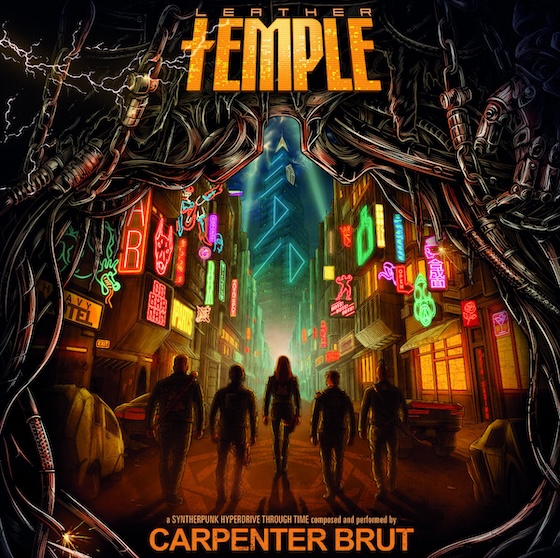
Somewhere past 2 a.m., when the city stops performing and starts revealing its circuitry, Leather Temple kicks in like a power surge—sudden, blinding, and impossible to ignore. Carpenter Brut doesn’t ease you into this record—he drops you straight into a chrome corridor lit by malfunctioning neon and something watching from the far end, humming in time with the beat.
This album feels less like a hallway and more like a nave: towering, metallic, sacred in a way that doesn’t forgive. The air is charged, cathedral-still before the rupture, then violently alive—no introductions, no exits, just momentum and pressure closing in from all sides. The synths don’t shimmer; they grind, flicker, pulse like exposed wiring in a storm, and every drum hit lands like a commandment carved in voltage. This isn’t a place you explore—it’s a place that processes you, reshaping your pulse to match its own relentless tempo.
In the neon underworld of modern synthwave, Carpenter Brut didn’t just show up—he kicked the doors off the hinges and rebuilt the room as something darker. Emerging in the early 2010s, he took the genre’s love of ‘80s horror soundtracks and sharpened it into ritualistic excess—louder, meaner, more theatrical. Where others painted sunsets, Brut raised cathedrals: black leather, smoke-choked air, and beats that felt like sermons delivered at unsafe volumes. His early EP trilogy felt like contraband passed between night creatures, and by the time Trilogy arrived, he had already established his doctrine—gothic, cinematic, and just unstable enough to feel dangerous. In a scene full of nostalgia, he made something closer to worship.
And now Leather Temple arrives like the ritual completed—candles burned down to wax scars, amplifiers still glowing like relics. This isn’t a return to form; it’s a coronation. The shadows aren’t just revisited—they’re architected, reinforced, turned into something structural. The album feels like a chrome cathedral in motion, equal parts sanctuary and machine, where every beat echoes like footsteps across steel floors. If the earlier records were about discovering the occult, this one is about command—less mystery, more authority, every sound placed with cold precision. The night isn’t creeping in anymore. It owns the skyline.
As the final chapter of the “Leather” trilogy, the record doesn’t resolve—it escalates. The edges are sharper, the textures colder, and the sense of narrative has collapsed inward into pure sensation. This is demolition music: controlled, deliberate, but devastating all the same. The opener, “Ouverture (Deus Ex Machina),” looms like a cathedral awakening—low, ominous, reverent in a way that suggests something vast is about to move. “Major Threat” answers with brute force, a floor-shaking pulse that feels like the congregation surging forward. The title track, “Leather Temple,” is pure procession—groove and menace intertwined, a march beneath flickering neon stained glass.
The middle stretch expands the space without offering relief. “She Rules the Ruins” carries a regal decay, like a queen presiding over a kingdom of rusted circuitry. “Start Your Engines” injects velocity—steel and speed, the liturgy of motion—while “Neon Requiem” offers a brief, haunting glow, a moment of reflection distorted through synthetic light. That softness is quickly sealed off by “Iron Sanctuary,” which tightens the walls again, turning the cathedral into a bunker—industrial, suffocating, absolute.
By the final run, the sermon turns into a warning. “The Misfits / The Rebels” is defiance at full volume, chaotic and unyielding, while “Speed or Perish” pushes everything to its breaking point—no balance, no mercy, just acceleration as doctrine. Then “The End Complete” arrives like the power finally cutting out—not explosive, but terminal. A shutdown. A silence that feels engineered.
What lingers after Leather Temple fades isn’t a melody—it’s architecture. Carpenter Brut has stripped synthwave of its nostalgia and reforged it into something colder, more imposing, more devout. These aren’t just songs—they’re structures you move through, systems you’re absorbed into. Power surges and chrome cathedrals, built not for comfort, but for transformation. And when it’s over, you’re left standing in the dark, unsure if you just listened—or if something rewired you permanently.
Purchase here: https://carpenterbrut.bandcamp.com/album/leather-temple