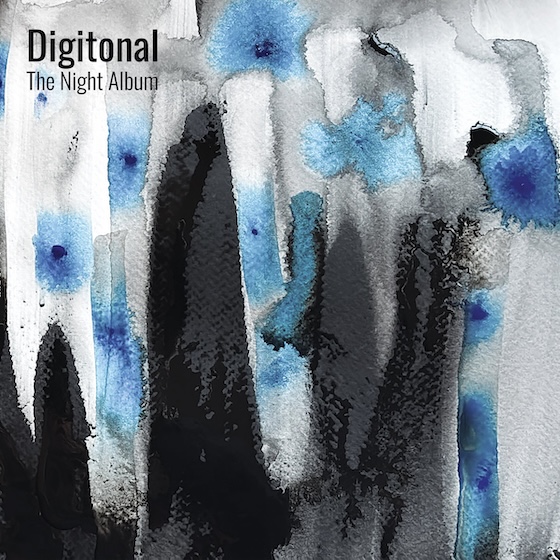
By the time The Night Album reached its final notes, I'd forgotten I was supposed to be reviewing it. My notebook had gone untouched, the wine glass was nearly empty, and somewhere along the way Andrew Dobson—better known as Digitonal—had quietly turned the room into something that felt a little smaller, a little calmer, and infinitely farther from the noise waiting outside the window.
That's a difficult trick to pull off. Ambient records often drift into the background, becoming expensive wallpaper while life continues around them. Dobson has never been interested in that kind of passive listening. Even at his most restrained, there's an emotional current beneath the surface that gently keeps pulling you forward. On his fifth studio album—and his first written, performed, and produced entirely on his own—that current feels stronger than ever.
There isn't a moment on The Night Album that begs for attention. Instead, it earns it a little at a time. Piano phrases bloom naturally before dissolving into softly breathing electronics. A clarinet enters almost like another thought crossing your mind rather than a featured instrument. Jazz colors the harmony without ever announcing itself, while generative textures add movement that feels less programmed than discovered. Nothing sounds rushed. Nothing sounds forced. Dobson trusts the listener enough to leave space between the notes, and that trust is rewarded.
"The Winter Journal" opens the album with quiet purpose, setting a reflective tone that never feels melancholy for its own sake. "dotdotdot" introduces subtle rhythmic motion, like footsteps on an empty street after midnight. Then comes "For the Birds," one of the album's defining moments. Floating piano chords, distant vocal echoes, and an expressive clarinet line circle around delicate IDM-inspired rhythms that seem to shimmer rather than pulse. It's the point where the album stops feeling like a collection of compositions and begins feeling like a place.
That atmosphere carries effortlessly through "Exit City" and "The Night Sparrow," each expanding the record's nocturnal landscape without repeating ideas. "Evening Song" is given room to unfold over nearly seven minutes, never overstaying its welcome because every phrase feels like part of the same quiet conversation. By the time "Sisters," "Sparrowhawk," and the closing "Moon Sequence" arrive, the destination hardly matters anymore. The journey has become the experience.
What impressed me most wasn't the musicianship—though it's exceptional—nor the production, which is warm, detailed, and wonderfully intimate. It was Dobson's confidence to let silence do some of the storytelling. In a musical landscape where every moment is often filled to capacity, The Night Album understands the value of restraint. It allows ideas to breathe, emotions to linger, and listeners to meet the music halfway.
When the album ended, I found myself doing something I rarely do anymore. I didn't immediately reach for another record. I sat there for a while, finished the last sip of wine, and let the quiet settle back into the room. Some albums leave you humming a melody. Others leave you thinking. The Night Album - which can be picked up here - leaves you listening . . . to the music, certainly, but also to everything that comes after it.