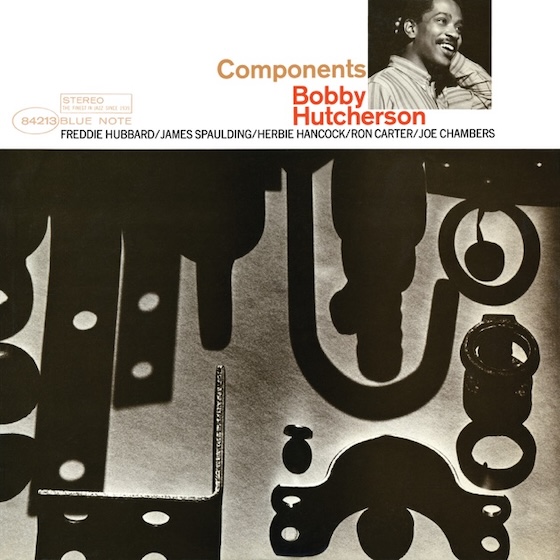
The room is already dim before I drop the needle, but Components somehow makes it darker in the best possible way. A single lamp glows amber across the wall, rain slips softly against the window, and a glass of red wine slowly warms in my hand. The kind of night where silence feels heavy unless the right record cuts through it. Bobby Hutcherson’s Components doesn’t arrive like a performance so much as a mood spreading across the room. From the first moments, the album feels suspended between late-night city lights and something more inward, almost dreamlike. Hutcherson plays the vibraphone with this incredible cinematic sense of space — not flashy, not crowded, never pushing too hard. Notes hang in the air like cigarette smoke in an old noir film, glowing for a second before disappearing into shadow. Sometimes the vibes shimmer softly behind the group, other times they cut through the session like flashes of light across wet pavement.
The lineup alone on this Blue Note record from ‘66 is enough to pull you in forever: Bobby Hutcherson on vibes, Freddie Hubbard on trumpet, James Spaulding on alto saxophone and flute, Herbie Hancock on piano, Ron Carter on bass, and Joe Chambers on drums. A room full of players already pushing beyond straight hard bop by 1965, searching for something more atmospheric, more open-ended. You can hear that searching all over this record.
What separates Hutcherson from so many vibraphonists is the way he treats the instrument almost cinematically. He isn’t just soloing over structures — he’s shaping light, texture, shadow. Notes shimmer, fade, reappear. Sometimes the vibes glow softly behind the band like distant neon through fogged glass. Other times they cut sharply through the session, cold and metallic for a split second before disappearing again. There’s restraint in his playing, but also tension. He knows exactly when to leave space hanging in the air.
The title track, Components, opens the album with this uneasy forward motion. Joe Chambers keeps the rhythm loose underneath while Herbie Hancock constantly shifts the harmonic ground beneath everybody’s feet. Nothing settles for very long. Freddie Hubbard plays with urgency, but Hutcherson stays strangely calm in the middle of it, almost observing the movement around him instead of getting swept into it. The whole thing feels alive, slightly unstable, beautifully unresolved.
Then Tranquillity arrives and changes the temperature of the room completely. The pace slows to a near drift. Hutcherson’s vibes barely seem struck at times — they hover. Dissolve. Herbie Hancock leaves enormous spaces between chords, letting silence become part of the arrangement itself. There’s something deeply nocturnal about the track. It feels less like a jazz performance and more like a slow camera pan through empty streets after midnight, reflections stretching across wet pavement while the city exhales somewhere far off in the distance. Freddie Hubbard holds back here too, choosing softness over force, and Joe Chambers’ drumming is almost ghostly underneath it all. Nobody overplays. Nobody breaks the mood. The restraint becomes the emotion.
Little B’s Poem still lands like a quiet emotional release every time I hear it. Hutcherson wrote it for his son, and you can feel that warmth immediately. The melody is simple, direct, almost fragile. No unnecessary complexity. Just this beautiful sense of tenderness sitting at the center of the album. Hutcherson’s phrasing here is incredible because of how patient it is. He lets notes ring out fully before moving forward, allowing the room itself to become part of the music.
Then there’s West 22nd Street Theme, which brings movement back into the record without losing the late-night atmosphere hanging over everything. Ron Carter’s bass playing is unbelievable here — constantly moving underneath the tune with these melodic runs that quietly push the entire band forward. Hancock adds nervous little harmonic turns that keep the track slightly unsettled, while Hutcherson sharpens his attack just enough to match the energy without abandoning the dreamlike mood entirely. It sounds like Manhattan after midnight. Empty intersections. Flickering streetlights. Taxi headlights sliding across rain-soaked sidewalks. The music moves, but it never hurries.
And then Air. Maybe the most overlooked piece on the record, but one of the most revealing. The track feels suspended between structure and abstraction, almost dissolving as it unfolds. Hutcherson’s vibraphone work here is especially striking because of how lightly he touches the melody — barely grounding it before letting it drift away again. Spaulding’s flute adds this hazy, weightless texture that gives the piece its title in a very literal sense. Everything feels airborne. Floating. Joe Chambers plays with extraordinary sensitivity underneath it all, never locking the group into anything too rigid. The track breathes instead of swings. There’s an eerie beauty to it, like watching cigarette smoke curl upward in slow motion beneath dim bar lights. You can hear the band stepping further outward here, closer to the spiritual and avant-garde directions jazz would continue exploring later in the decade.
That’s really what makes Components stay with you long after it ends. It never forces emotion. Never announces its importance. The album just slowly fills the room, changes the atmosphere around you, and suddenly an hour has disappeared. Hutcherson understood texture the way great filmmakers understand lighting — knowing exactly what to reveal and what to leave partially hidden in shadow.
Drop the needle. Stay there.