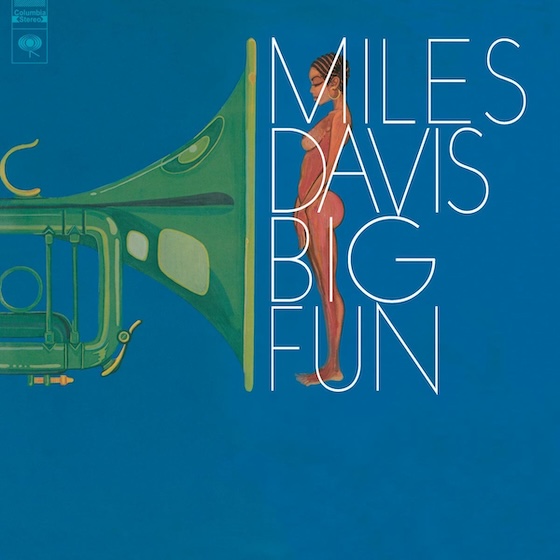
There are albums you listen to, and then there are albums that dismantle you piece by piece until you’re just drifting circuitry and nerve endings. Big Fun—that sprawling, electric fever dream from Miles Davis—belongs firmly in the latter category. Released in 1974 but stitched together from sessions spanning 1969 to 1972, Big Fun isn’t an album so much as a haunted transmission from the molten core of jazz’s most dangerous era. It’s smoke-choked music, dim-lit, and humming with something that might be genius or might be total psychic collapse.
Sounds like big fun, right?
The opening stretch doesn’t ease you in—it absorbs you. “Great Expectations” sprawls like a ritual in slow motion, built on a hypnotic pulse that feels less like rhythm and more like gravitational pull. Davis’ trumpet doesn’t soar here; it flickers, disappears, and re-emerges like a signal fighting through interference. The band—stacked with electric keys, guitars, and layered percussion—doesn’t accompany so much as conjure them. It’s less jazz ensemble and more séance. You don’t follow melodies; you wander through them, unsure if you’re hearing structure or hallucination.
On Big Fun, the groove isn’t something you lock into—it’s something you fall inside of. Jack DeJohnette treats time like a liquid, his cymbals shimmering and bending the pulse until it feels unmoored, while the bass—whether it’s Harvey Brooks laying down a thick electric throb, Dave Holland moving in restless, searching lines, or Michael Henderson hammering a deep, hypnotic vamp—anchors you just enough to keep from drifting into the void. But even that anchor isn’t fixed; it loops, it breathes, and it mutates. The rhythm section doesn’t “swing” or “funk” in any traditional sense—it circulates, a dense, polyrhythmic current where everything is in motion at once, closer to a living system than a band, stretching groove into something immersive, disorienting, and strangely addictive—and yeah, metal bands know this: the repetition, the shifting layers, the way a riff or pattern can become a vortex rather than a structure, it’s the same principle, just electrified differently.
Then there’s “Ife,” a side-long descent that stretches time until it snaps. This is where Big Fun reveals its true teeth. The groove is deceptively simple, almost meditative, but the longer you stay inside it, the more it mutates . . . you. Damn. Instruments blur. Identities dissolve. Herbie Hancock’s electric piano seeps into the rhythm section, and Davis hovers—distant, watchful, surgical. No clean release. No tidy resolution. Just pressure. Constant, tightening pressure. It’s oppressive, beautiful, and quietly terrifying.
“Go Ahead John” fractures the whole thing wide open. Tape edits slice like razors. John McLaughlin’s guitar multiplies, overlaps, and cannibalizes itself. The track feels assembled and disassembled at the same time. And here’s where it gets dangerous—where the bridge appears. You can hear the DNA of technical death metal lurking in the chaos: the obsession with precision inside madness, the layered complexity, the sense that virtuosity is being pushed past human comfort into something alien. Not in sound, not in tone—but in intent. This is the same restless architecture that bands decades later would weaponize into blast beats and labyrinthine riffing. Davis didn’t play metal. But he absolutely cracked open the door that that kind of extremity would eventually walk through.
And then “Lonely Fire.” After the storm, but not peace—never peace. Just embers. Just smoke. The track breathes, but it’s a strained breath, like lungs still adjusting after impact. Davis plays with restraint, which somehow cuts deeper than the earlier density. Every note feels deliberate. Every silence feels loaded. It doesn’t comfort you. It leaves you alone with what just happened.
Big Fun isn’t an entry point for anyone new to the scene. It’s a threshold. You don’t put this on casually—you commit to it, and it commits right back. This is Miles Davis unbound, uninterested in genre, uninterested in resolution, and uninterested in you being comfortable. For Deadwax Noir, it’s essential listening: a record that doesn’t just break you—it studies the fracture, maps it, and hands it back like a blueprint.
Big Fun might break you, but it’ll leave something behind in the wreckage that feels a lot like truth. Drop the needle. Stay there.