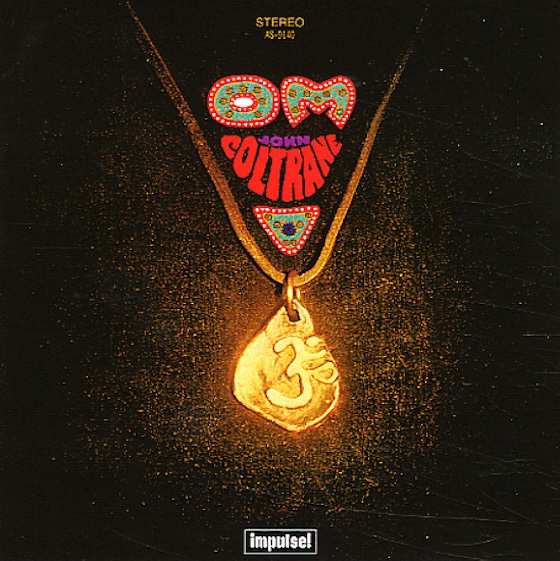
There’s a reason John Coltrane’s Om still feels like it landed from somewhere ahead of us, not just outside its own era.
Recorded in October 1965 but not released until 1968, Om sits in a strange pocket of time. By the moment it hit the public, the ground had already shifted—Coltrane himself had moved further into spiritual free jazz, and the wider culture was deep in upheaval. But even in that context, Om didn’t sound like “the present.” It sounded like a transmission from a future that hadn’t learned how to speak yet. Raw, ecstatic, almost confrontational in its devotion.
What’s wild is that 1965 wasn’t exactly conservative terrain. Coltrane had already torn through A Love Supreme, already stretched harmony and form to the brink. Free jazz was alive. Ornette Coleman had cracked things open. Albert Ayler was screaming into the void. And still—Om feels like it’s operating on a different frequency altogether. Less “music” in the traditional sense, more ritual. Breath, chant, eruption. A collective reaching.
In Om, the ensemble doesn’t behave like a lineup—it feels like a convergence. Pharoah Sanders burns through the mix, his tenor a blast of torn metal and молитва, overblown and unfiltered, the sound of the door getting ripped clean off its hinges; beneath that, Donald Garrett murmurs on bass clarinet, low and woody, like something speaking up from the floor itself. McCoy Tyner hammers clustered chords that feel less like harmony and more like force—percussive, tidal—while Jimmy Garrison circles the center with lines that repeat like a mantra beginning to fray. Driving it all, Elvin Jones unleashes a storm of polyrhythms that never quite land, only surge forward, and Joe Brazil threads in alto and flute textures—less defined, maybe, but essential—another current in the swelling mass, until the whole thing stops sounding like individuals and becomes a single, heaving presence.
The album opens not with a groove, not with a theme, but with a reading—a chant pulled from sacred text. Then it explodes. The band doesn’t so much play as surge. Horns spiral, drums scatter, voices rise and fall like something between prayer and possession. It’s not structured in the way listeners expect; it’s shaped like an experience. You don’t follow it—you endure it, or surrender to it.
And that’s where the “future-farming” idea really lands. Om isn’t predicting jazz’s next technical step. It’s pointing toward something more abstract: music as spiritual technology, as communal trance, as a break from Western form entirely. In some ways, it anticipates later experimental scenes—noise, drone, even aspects of avant-garde rock and spiritual improvisation. Not directly, not cleanly, but in spirit. In intent.
So what was its time? Not 1965, even though that’s when it was born. Not 1968, when it finally arrived to a confused audience. Its time is fractured—part late-Coltrane transcendence, part something still unresolved. It feels like an artifact from a moment when jazz stopped asking “what’s next?” and started asking “what is this, really?”
And maybe that’s why it still hits the way it does. Not dated. Not even timeless. Just… unmoored.
When you listen to Om, you’re not easing into a mood, you’re stepping into a room that was already in progress. Voices mid-chant. Air thick. The tape feels hot, like it’s barely containing what’s happening. John Coltrane isn’t leading so much as opening a door—and everyone barrels through it at once.
This is the space where the usual listener instincts fall apart. There’s no safe perch, no clean entry point. You’re inside the breath, the spit, the overblown reed, the collective surge. The band doesn’t resolve tension—they inhabit it. It’s a long-form exorcism, or invocation, depending on how you hear it. Either way, it doesn’t let you hover at a distance.
This is where Deadwax Noir thrives: in that locked groove between revelation and unease. The moment where sound becomes environment. Om isn’t spinning for you—it’s circling something older, darker, maybe sacred, maybe dangerous. And the longer you stay, the less you’re sure which.
So yeah. Don’t reach for the lift. Let this beast play out like a ritual you don’t fully understand—but can’t walk away from.
Drop the needle. Stay there.