She slides the record from its sleeve as if the weight matters—because it does. Fingertips careful on the edges, eyes catching the faint sheen of black wax under a low lamp. The room is quiet except for the soft crackle of anticipation, the kind that hangs in the air before something real begins. Needle poised, breath held, she lets it drop—and just like that, the world narrows. The first pulse hits, warm and immediate, and she sinks into it. Not background music. Not noise. A mood, a space, a ritual. Something to feel all the way through.
And she is transported somewhere else altogether.
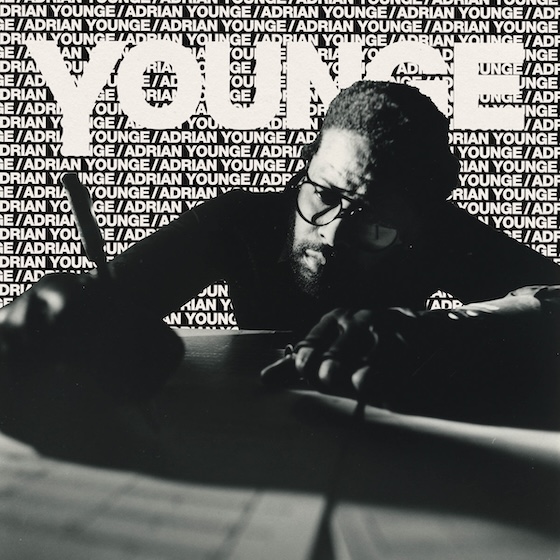
Younge, the latest release from Adrian Younge, hits with purpose from the first note; he’s locking strong, deliberate beats into place beneath waves of lush orchestration that feel built for the screen as much as the speakers. This is music that doesn’t just suggest imagery—it demands it. Every track unfolds like a scene waiting for a camera, a narrative hovering just out of reach, carried by arrangements as disciplined as they are emotionally charged.
“Portschute” opens the record with immediate cinematic weight, horns rising like a warning signal over a steady, unshaken pulse. It’s tense, deliberate, and sets the tone without overplaying its hand. “Human Absence” follows with a colder, more distant feel—strings stretching into negative space, letting silence do as much talking as the instrumentation. By the time “Galt” and “Moon Traveling” arrive, Younge is fully immersed in motion, shifting between grounded rhythm and weightless drift, like scenes cutting between street-level grit and something more cosmic.
There’s a fluidity across the middle stretch—“Different Directions” and “Visual Assault” push the rhythm forward, the hypnotic beats digging in deeper while the orchestration swells and recedes around them. It’s here the hip-hop foundation feels most pronounced, not through obvious loops but through feel—through timing, weight, and restraint.
There is a deep historical awareness here—echoes of Lalo Schifrin’s taut cinematic tension, David Axelrod’s psychedelic soul architecture, Ennio Morricone’s expansive drama, Galt MacDermot’s rhythmic boldness, and Geoff Barrow’s shadowy, sample-minded atmospherics—all composers whose works fed directly into hip hop’s DNA through decades of crate digging and sampling. Younge doesn’t just reference them—he extends their lineage, translating that sampled past into a fully realized, live composition.
“Respond to Sound” and “Clockwise” tighten things up, more contained, almost mechanical in their precision, before “Il Mattino” closes things out with a sense of quiet resolve, like the final frame fading to black.
And through it all—those swelling strings. They don’t just accompany; they rise, crest, and pour over everything with a kind of emotional gravity that borders on spiritual. There’s sweetness here too—syrupy, rich, and so, so very righteous that you can’t help but feel it in your chest, like a quiet invocation. The beats keep you grounded, the orchestration lifts you somewhere higher, and in that space between, the record finds its power. You don’t just listen—you respond. You raise a hand and bow your head. Amen.
What holds it all together is Younge’s commitment to space and texture. Recorded to tape, every element breathes—nothing feels overworked or artificially polished. The beats knock, but they never overwhelm. The orchestrations are rich, but never indulgent. It’s a balance that gives the record its staying power, allowing each track to exist as both a standalone piece and part of a larger, unseen film.
This is music that feels incomplete in the best way—not lacking but open, waiting to be paired with visuals, stories, and movement. Younge doesn’t just blur the line between hip hop and orchestral composition—it builds something entirely its own, a body of work that lives somewhere between the studio and the screen, fully realized yet always inviting more.
You can find Younge through Linear Labs or track it down wherever you dig for vinyl—either way, it’s a record worth holding in your hands.
As always, drop the needle. Stay there.