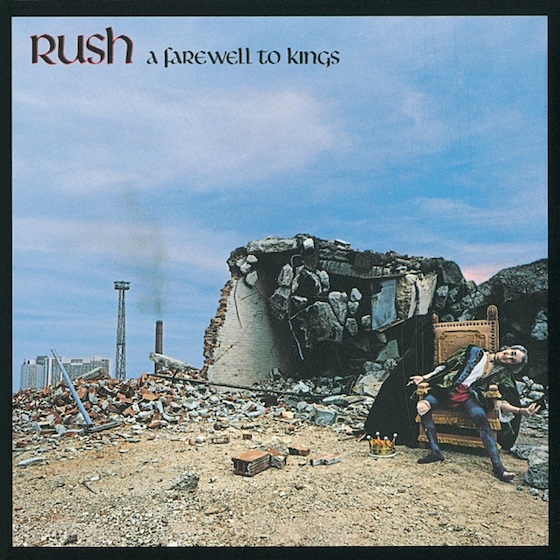
You’re going to think I’ve lost it, but A Farewell to Kings isn’t as far from technical death metal as it should be. Yeah—I hear it too. It sounds ridiculous. But this isn’t about distortion or speed or any of the obvious markers. It’s about how the songs move. Or don’t. Or just refuse to sit still long enough to behave like normal songs. Rush figured out something there—not a sound, but an approach. Build in sections. Let ideas evolve instead of loop. Let parts pull against each other. Don’t rush resolution. Just keep things in motion.
And that idea doesn’t stay put. It gets picked up, tightened, and warped. Watchtower turns it surgical—precision pushed to the point of discomfort. Voivod bends the structure until it feels unstable. Fates Warning stretches it into something more narrative. Then it gets heavier—Death compresses that movement into pressure. Atheist strips repetition almost completely out of the equation, and by the time Obscura gets hold of it, the whole thing has been pushed into something dense, hyper-detailed, and almost alien.
Different sound. Obviously. But the instinct—that refusal to settle, that need to keep evolving even when it makes things harder—that’s the through line. Say it out loud and it still sounds like a stretch. I get it. But listen to how it’s built, not just what it sounds like.
That’s where it lines up. That’s where the mutation starts.
I didn’t land on this stupid idea overnight. It wasn’t some grand theory I set out to prove. It just kind of crept in over time—late nights, headphones on, going back to the same records and noticing things I’d somehow missed before. At a certain point, it stopped feeling like a stretch and started feeling… obvious, in a weird way.
Okay, hear me out—start with “Xanadu.” No, seriously. Don’t skip ahead. The opening? Lifeson just lets those chords hang there like he’s daring you to get comfortable. And you almost do. Almost. Then—boom—not even a boom, more like the floor tilts and suddenly you’re somewhere else entirely. It’s not a payoff. It’s a shift. A sideways move.
And Geddy—he’s not behaving. He never really does, but here it’s especially noticeable. He’s not under the guitar; he’s around it, sometimes ahead of it, sometimes pulling against it like he’s testing how far things can stretch before they snap. You can almost hear him thinking, “What if I don’t do the obvious thing?” And then he doesn’t.
Peart? That’s a whole other conversation. Or maybe it isn’t—maybe it’s the same one, just louder. He’s not keeping time so much as negotiating with it. Nudging it. Interrupting it. Letting it breathe for a second and then tightening the screws again. You settle in for a groove, and he’s already moved it half a step to the left.
And that’s where it gets weirdly familiar.
Because it doesn’t loop. Not really. It doesn’t give you that comfortable return point. It just keeps going—forward, sideways, occasionally in circles, but never the same circle twice. It feels assembled. Like parts clicking into place, sometimes awkwardly, sometimes perfectly, but always with intent. I remember putting on Atheist’s Unquestionable Presence years later and catching myself thinking, Wait—why does this feel familiar? Not the sound. Something underneath it. The movement.
And before this turns into a two-song argument, it’s worth pausing on the quieter corners—because they matter more than they look like they should.
“Cinderella Man” has more of a traditional backbone, sure, but it still refuses to sit still. The transitions come quicker than you expect, sections pivot without much warning, and the band keeps threading little variations through what could’ve been a straight-ahead rocker. There’s a looseness to it, but not sloppiness—more like they’re testing how much they can bend a conventional frame before it gives way.
“Madrigal” is all too easy to write off as a breather. Short, delicate, almost suspiciously straightforward. But listen to how it resolves tension rather than building it. The chords don’t quite land where your ear expects them to; they soften the edges without smoothing them out. It’s like the band proving they can restrain themselves, then choosing not to elsewhere. That sense of control—knowing exactly how far to push or pull—feels like the flip side of the same instinct that drives the more complex material. Even in something this compact, there’s intention in every turn.
Then “Cygnus X-1” hits, and—okay, this is where I started second-guessing myself. There’s that stretch in the back half. You know the one. Everything tightens up, gets darker, almost mechanical. Guitar and bass locked in, circling this figure that feels like it’s going somewhere bad. And Peart—again—just keeps shifting the ground enough that you can’t quite plant your feet.
It doesn’t resolve. Not when you expect it to. It just builds. And builds. And you’re sitting there thinking, “Are they going to let this breathe?” And the answer is"not really."
The first time I really heard that section—not just listened, but actually paid attention—I had this dumb, immediate thought: push this harder. Faster. Dirtier. Strip the polish and add some teeth. And suddenly you’re not a million miles away from something way more extreme.
Which sounds ridiculous. I know. But underneath all the surface differences—the tone, the aggression, the aesthetics—the thinking lines up more than you’d expect. That’s the part that won’t leave me alone.
Everyone’s doing their own thing.
I’m not saying anyone in the early ’90s was sitting around with this album on repeat, taking notes. That’s not how this stuff travels. It’s messier than that. But Rush—this version of Rush—opened a door. Or maybe just cracked it enough that someone else could kick it down later.
Long forms. Shifting structures. Precision that doesn’t feel sterile. The idea that difficulty isn’t a side effect—it’s the point. So yeah, say it out loud, and it still sounds like a stretch. I get it. I’d probably laugh it off too if I hadn’t spent way too much time sitting with both ends of this spectrum.
But go back. Seriously. “Cygnus X-1,” second half. Don’t multitask. Just sit with it.
Tell me you don’t hear something—a blueprint for how complexity could function in heavy music—all the way back in 1977.














![Pirates of the Caribbean: 5-movie Collection 4K UHD + Blu-ray [Region Free]](/images/resized/images/stories/2026/pirates-caribbean-collection_40_40.jpg "Pirates of the Caribbean: 5-movie Collection 4K UHD + Blu-ray [Region Free]")