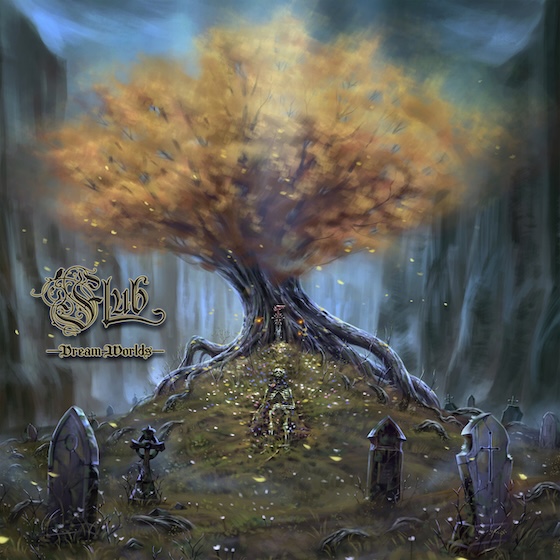
There is a certain kind of album that does not feel like a collection of songs so much as a passage you step into, and Dream Worlds by Flub opens exactly that kind of door. It begins less like a performance and more like a camera drifting through some impossible expanse, the frame widening until your sense of scale gives out. The guitars do not just riff, they unfold, curling inward and then stretching back out as if they are tracing the edges of something too large to fully grasp. You find yourself adjusting in real time, recalibrating, realizing almost immediately that this is not about brute force alone. Every turn feels intentional. Beneath all the speed and pressure, there is something almost reverent.
Flub emerged from Sacramento with a sound that always leaned toward the melodic side of technical death metal, threading neoclassical ideas through dense, high velocity structures. There is a lineage running through their work, a connection to players and scenes that value composition as much as precision. On Dream Worlds, that balance feels especially sharp. Michael Alvarez handles vocals with a presence that feels fused to the music rather than laid over it, while Eloy Montes shapes the album’s identity through intricate, fluid guitar work that never loses sight of the larger picture. The rhythm section is rounded out by session players Andrew Kim on bass and Eric W. Brown on drums, both of whom bring the kind of control and adaptability this material demands. Together, they sound less like a pieced together lineup and more like a focused unit built to carry out one very specific vision.
To put it plainly, Dream Worlds is focused. Four core tracks, no wasted movement, each one hitting with purpose and moving on. It plays like a sequence of tightly cut scenes instead of sprawling epics, and that economy gives the record an unusual force. It feels like a final statement shaped through refinement rather than excess, a band honing its language right at the edge of vanishing.
“Leaves of Gold” arrives first, quick and luminous, setting a tone that feels almost deceptive in its clarity before the deeper currents start pulling through. It builds layer by layer, letting motifs settle just long enough to leave an imprint before twisting them into something new. The drumming chatters and snaps with machine grade precision, but it never loses its pulse or urgency. There is always a human risk in it, as if the song is running flat out along the edge of collapse and never slipping. “In Soil Sleeps Secrets” tightens the frame. It feels more compact, more inward, less like it starts than like it appears already in motion. The band locks into hypnotic passages and then tears them apart without warning, scattering the pieces in every direction. It has the force of cinema in the best sense, hard cuts between scenes that somehow still preserve a continuous emotional line.
Then “Paracosm” opens everything back up. Melody rises and hangs in the air with an almost unreal lightness, giving the record one of its most striking shifts in perspective. Just as important are the instrumental versions included alongside the main tracks. They do more than offer an alternate listen. They expose the architecture. With the vocals removed, you hear how carefully every section is built, how deliberately ideas are introduced, transformed, and returned to. Nothing feels decorative. Every part has weight.
By the time “The Wasteland” closes the record, the lens has narrowed again. Where earlier moments expanded and hovered, this one draws everything inward with exacting control. It does not suffocate. It sharpens. The confidence in the album’s pacing becomes impossible to miss by this point. Flub know when to surge forward and when to hold a phrase in place just long enough for it to resonate. The interplay becomes the real story. Bass moves through the guitars rather than merely beneath them. Drums shift from propulsion to conversation. What you hear starts to feel less like a band performing and more like a living system in motion, intricate, severe, and completely alive.
By the end of Dream Worlds, there is a sense that you have been taken somewhere and returned without ever fully understanding the route. The album does not explode or drift away. It resolves. It comes into focus. What lingers is not just the technical mastery, though that is undeniable. It is the feeling of having brushed against something immense, structured, and strangely beautiful. Not chaos. Not noise. Something deliberate, almost righteous in its construction, and more than a little overwhelming in its scale.
While we patiently await the release of their next album, Dream Worlds can be picked up wherever the finest of records are sold or here: https://flub.bandcamp.com/album/dream-worlds