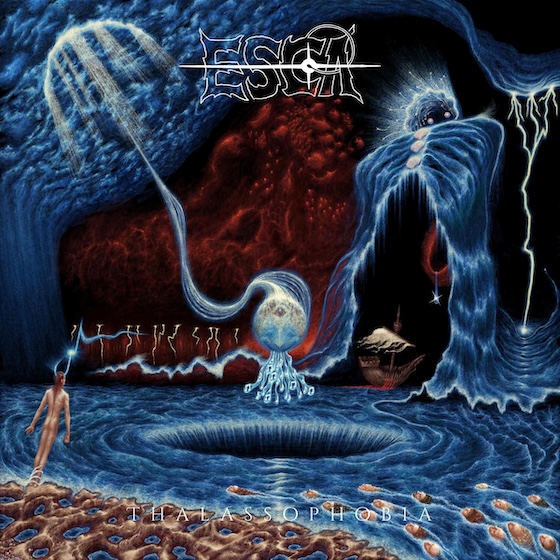
Esca’s Thalassophobia is the sort of progressive death metal record that makes technical proficiency feel dangerous again. The Bristol four-piece clearly knows its way around complicated arrangements, shifting rhythms, and muscular riff construction. Still, none of that skill is allowed to turn the album into some sterile exercise in musicianship. Instead, Esca takes the progressive instincts of bands like Opeth and Mastodon and pushes them through something darker, heavier, and distinctly their own. Across eight tracks and roughly forty minutes, Thalassophobia moves with the confidence of musicians who understand that complexity means absolutely nothing if the songs don’t actually go somewhere.
And these songs fucking move. “Flood,” “Basilisk,” and “Fel Reaver” establish an album built upon enormous guitar passages, restless percussion, and riffs that twist around themselves without losing their physical impact. There is serious skill on display here, particularly in the rhythmic interplay among guitars, bass, and drums, yet Esca never seems interested in stopping the record so everyone can admire how clever they are. The playing serves the songs, not the other way around. That distinction matters because Thalassophobia can absolutely flatten you when it wants to, but beneath all that progressive death metal muscle is an unexpectedly fluid sense of movement.
The real surprise, though, comes from the melodic passes woven throughout the brutality. Esca understands that heaviness becomes considerably heavier when there is something beautiful sitting beside it, and those cleaner guitar passages, atmospheric transitions, and melodic stretches give the record room to breathe before another wall comes crashing down. Instrumental centerpiece “Ascent of the Oarfish” emphasizes just how comfortable the band is allowing texture and musicianship to carry the narrative without vocals, while the title track and sprawling back half demonstrate an impressive ability to move between aggression and atmosphere without sounding stitched together. Those melodic passages aren’t concessions to accessibility; they are part of the architecture.
Then there are the sonics. Mixed and mastered by Neil Hudson at Grindfarm Studios, Thalassophobia sounds fucking enormous without becoming another over-compressed modern metal brick. The guitars have weight and definition, the drums punch instead of merely triggering explosions, the bass remains an actual presence, and the vocals sit inside the attack rather than suffocating everything beneath them. There is space here, which might be the most important ingredient considering the album’s deep-water imagery: you can hear the individual players while still feeling the full mass of Esca bearing down on you. Technical, melodic, punishing, and beautifully produced, Thalassophobia announces a band already frighteningly comfortable with its abilities—and smart enough to know exactly when to show them off.
It can be unearthed here or wherever you dig up the filthiest of metal.














![Trick or Treat (1986) – 4K Ultra HD [Standard Edition]](/images/resized/images/stories/2026/trick-or-treat-4k_40_40.jpg "Trick or Treat (1986) – 4K Ultra HD [Standard Edition]")