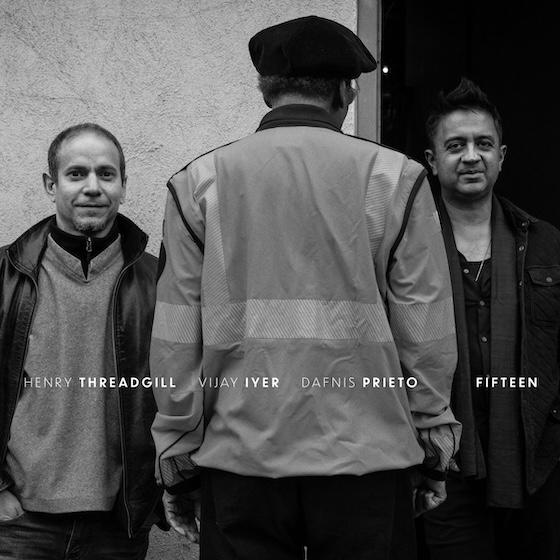
There’s something wonderfully dangerous about a jazz trio with no bass player. No safety net, no dependable low-end thump keeping everybody honest, no guy standing in the corner dutifully reminding the room where the floor is. On Fifteen, released August 21, 2026, on Nonesuch Records, Henry Threadgill brings the alto saxophone and flute, Vijay Iyer sits behind the piano, and Dafnis Prieto handles the drums, and the three proceed to spend roughly 48 minutes proving that the missing instrument isn’t really missing at all. The space where the bass should be becomes part of the damn music. Notes hang there, rhythms stumble into it, Threadgill blows straight across it, and Iyer occasionally seems determined to kick a piano through it. This isn’t three musicians politely waiting for their turn to solo. This is conversation—occasionally friendly, occasionally argumentative, and frequently conducted in a language the rest of us are still trying to learn.
The title Fifteen refers to the years these three have spent performing together, a relationship that began with appearances benefiting New York’s Jazz Gallery and continued through performances around the United States and internationally. Remarkably, this is their first album together as a trio, and maybe that long gestation is why nothing here feels hurried or desperate to impress. They already know what the others can do. More importantly, they know when to get the hell out of each other’s way. Threadgill can throw a crooked little phrase into the air and leave it hanging while Iyer pokes at its edges and Prieto rearranges the furniture underneath it. Then, without warning, all three lock together, and Fifteen stops sounding loose altogether. It becomes precise, complicated, and almost frighteningly alert, like three people who have been finishing each other’s sentences for years but have finally decided finishing them is boring.
That tension runs through the eight tracks—“Trio Piece,” “Last Night,” “I Wanted a Map,” “Where Coconuts Fall,” “Gently Trapped,” “Fire City,” “Perfect Victims” and “On the Way”—with three compositions apiece from Threadgill and Iyer and two from Prieto. Iyer also produced the record, but there’s nothing overly manicured about it. “Trio Piece” opens things almost deceptively, Threadgill’s flute moving around Iyer and Prieto with enough breathing room to make the absence of bass immediately noticeable, while “Last Night” starts twisting the relationship into stranger shapes. By “I Wanted a Map,” the title starts feeling like a joke at the listener’s expense because a map isn’t going to help much. The music keeps changing direction, sometimes beautifully, sometimes abruptly, and often just when you think you’ve figured out where the bastards are taking you.
The second half digs deeper into that unpredictability. “Where Coconuts Fall” stretches past seven minutes and gives Threadgill room to jab, retreat, and jab again while Iyer refuses to function merely as accompaniment and Prieto reminds us that drums don’t have to keep time so much as mess with our perception of it. “Gently Trapped” is exactly the sort of title this record deserves, while “Fire City” lets Iyer’s compositional voice pull the trio through another wonderfully unstable landscape. Yet Fifteen never becomes difficult simply for its own sake. There is humor in these performances, curiosity and, underneath all the angularity, an enormous amount of listening. That might be the album’s secret weapon. Nobody is trying to win. Nobody is showing off for the back row. Three heavyweight musicians are responding to one another in real time, and the pleasure comes from hearing how quickly the ground beneath them can move.
By the time Prieto’s “On the Way” closes things out, Fifteen has made its point without ever bothering to announce what that point actually is. Jazz, being adventurous, can sometimes arrive carrying homework, practically daring the listener to understand it before being permitted to enjoy it, but Threadgill, Iyer, and Prieto avoid that trap. You don’t have to understand every rhythmic displacement, compositional decision, or sideways turn to feel the electricity passing between them. In fact, trying too hard to solve Fifteen might be the wrong way into it.
Put the damn thing on. Turn it up. Let the empty spaces stay empty and quit waiting for the bass player who isn’t coming. After fifteen years together, these three finally made the record, and it sounds less like a destination than three brilliant musicians discovering there are still plenty of places left to wander through.