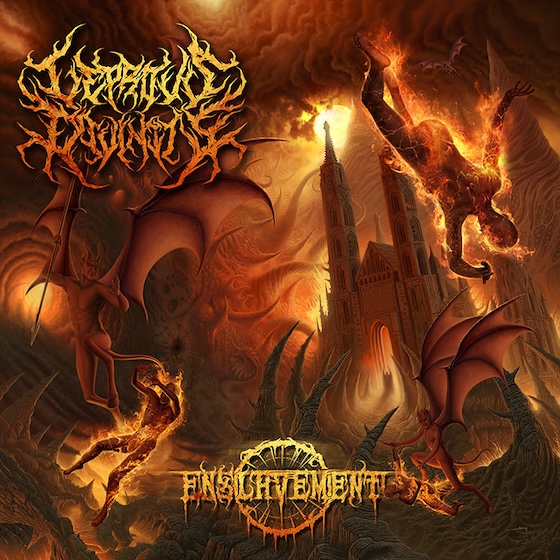
Enslavement feels even stronger when you place it in the context of Leprous Divinity themselves—a short-lived but striking San Francisco brutal death metal unit formed out of members with ties to projects like Son of Aurelius and Flesh Consumed. Active roughly from 2013–2014 and currently listed as “on hold,” with no full-length following this EP, they remain one of those bands that dropped a single vicious statement and vanished into myth a little. That almost adds to Enslavement’s aura.
What always struck me is how the EP doesn’t treat technical death metal as a proving ground for dexterity. It treats it like world-building. The riffs feel engineered, yes, but also cinematic—massive and foreboding, moving like collapsing architecture. There’s this dark, almost apocalyptic atmosphere stitched through the violence. Dissonant textures smear into these oppressive pockets of space; transitions feel less like “parts” and more like scenes dissolving into one another. It doesn’t just bludgeon. It stalks.
And that’s where Leprous Divinity distinguished themselves. A lot of tech-death goes clinical. This goes feral. The complexity here has grime under its fingernails. Rhythms twist in ugly, unpredictable ways, but always in service of tension. You can hear a young band already thinking compositionally—using brutality for scale, using dissonance for dread. Even the breakdowns feel cinematic, not merely mosh-driven but catastrophic, like impact sequences.
There’s also something almost visionary about how the production carries that. The guitars loom in layers. The drums don’t just mark time, they rupture. Vocals sound less like frontman performance and more like another spectral element inside the mix. That density gives the EP its strange visual quality—you don’t just hear these songs, you picture them.
And honestly, that’s what makes it frustrating there wasn’t more. Enslavement doesn’t sound like a band finding itself; it sounds like a band arriving. A debut this focused usually hints at something even more expansive coming next—a full-length pushing those cinematic textures further into something monstrous. But with the band apparently dormant or on hold, that promise hangs unresolved.
Still, there’s something kind of fitting about that. This EP exists almost like a relic from an unfinished future.
And I’ll say it plainly: I’d love to hear more from Leprous Divinity if they ever resurface. Because Enslavement doesn’t feel like a closed chapter—it feels like a prologue. The album can be purchased here: Leprous Divinity: Enslavement
As always, when the celluloid fades, the dissonance remains. Keep listening.