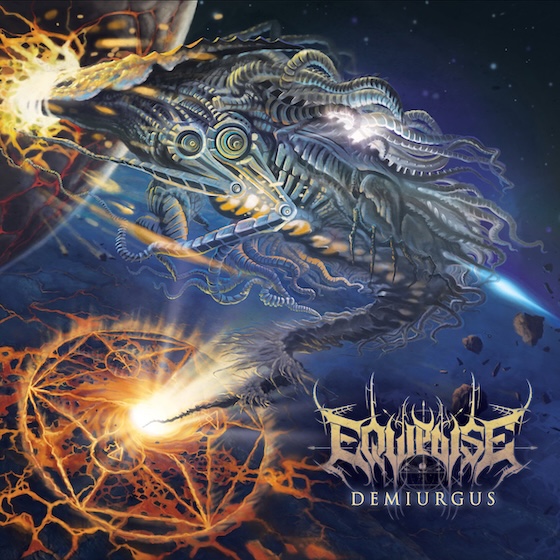
A low hum emerges from the void—distant, mechanical, almost celestial. It swells into a vast orchestral surge, as if some unseen force is breathing life into the cosmos itself. Flickers of melody spiral like constellations forming in real time, only to fracture under the weight of something darker, more chaotic. You’re not simply pressing play—you’re stepping into a transmutation circle, the air charged with intent, the outcome uncertain. This is the threshold of Demiurgus, where creation and destruction blur together, and the journey ahead promises both revelation and ruin.
Equipoise bring together a group of highly regarded musicians from across the technical death metal underground, spanning Pennsylvania, Illinois, Missouri, Denver, and Quebec. Their sound blends melodic technical and progressive death metal with sweeping orchestral elements and flashes of flamenco guitar, creating something that constantly pushes beyond genre boundaries. Drawing influence from bands like Gorod, Inferi, Necrophagist, Vale of Pnath, and Death, they craft a style that feels both rooted in the genre and boldly forward-looking.
Demiurgus, released in 2019, is the kind of debut that feels less like an introduction and more like an unapologetic declaration of excess—intentional, intricate, and overwhelming in scope. Brought to life by a lineup of elite musicians—vocalist Stevie Boiser, guitarists Nick Padovani, Phil Tougas, and Sanjay Kumar, bassist Hugo Doyon-Karout, pianist Jimmy Pitts, and drummer Chason Westmoreland—the album reflects a level of collective mastery that few debuts can claim. Inspired by Fullmetal Alchemist: Brotherhood, it plays out like a conceptual labyrinth, threading together themes of creation, transformation, and metaphysical identity. Equipoise lean fully into a “more is more” philosophy, but what’s impressive is how controlled it all feels; the chaos is deliberate, the complexity carefully shaped. With each listen, more details come into focus, revealing just how thoughtfully the band balances technicality with narrative flow.
One of the album’s most distinctive traits is its use of fretless bass, which refuses to stay tucked away in the background. Instead, it moves with a fluid, almost vocal quality, weaving through the guitars with counter-melodies that feel alive. The slides and subtle tonal shifts add an organic layer to an otherwise hyper-precise sound, giving the music a sense of motion and personality. It occasionally takes center stage in a way that might surprise listeners used to buried bass in tech-death, but here, it’s part of what makes Demiurgus feel so unique and immersive.
The flamenco and classical guitar elements are just as important to that identity. Rather than feeling like decorative interludes, they act as natural extensions of the songwriting. These nylon-string passages bring warmth and texture, offering brief moments to breathe between the album’s relentless intensity. At the same time, their rhythmic and melodic character adds a whole new dimension, reinforcing the album’s themes of duality—chaos and control, aggression and elegance—while showing just how far Equipoise are willing to push beyond genre norms.
Later in the album, “Squall of Souls” lands like a late-stage eruption—a blistering, relentless surge that feels like everything has been building toward this point. It barrels forward with a storm of riffs, blast beats, and soaring leads, but never loses its sense of direction. Motifs resurface and evolve, guiding you through the intensity rather than letting it spiral into chaos. The fretless bass winds underneath it all like a living current, while orchestral layers rise and fall around the band, giving the track a sense of motion and scale. It’s overwhelming in the best way, serving as one of the album’s most powerful and climactic moments.
Thematically, Demiurgus leans hard into ideas of alchemy, forbidden knowledge, and the cost of creation, all tied together by its Fullmetal Alchemist: Brotherhood influence. That conceptual backbone does a lot of heavy lifting, keeping the album grounded even as the music spirals into dizzying territory. At times, the sheer density and length can feel a bit exhausting—this isn’t a casual listen by any stretch—but that’s also part of its appeal. If you’re willing to meet it on its level, Demiurgus becomes more than just an album—it’s a full-on experience, a carefully crafted journey that keeps revealing new layers long after it ends.
While we patiently await their follow-up album, Demiurgus can be purchased here: https://equipoiseofficial.bandcamp.com/album/demiurgus