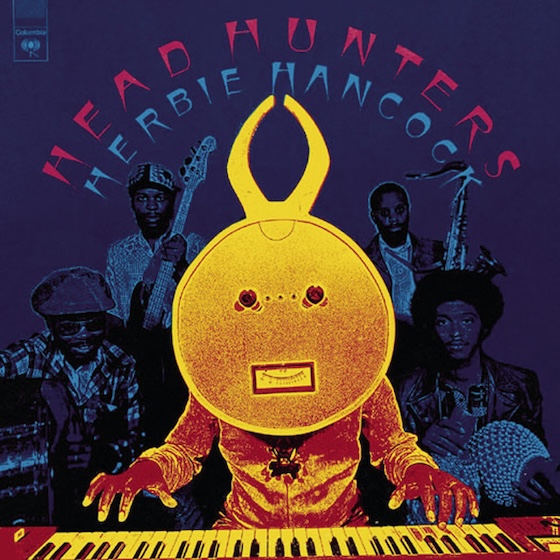
Some records arrive polished. Some arrive dangerous.
Head Hunters slithers in.
Released in 1973, this still feels illicit, less like an album than contraband passed between dimensions. There is funk here, certainly, but funk under pressure, mutating in sealed chambers. Something humid breathes inside these grooves. Something electric. Something nocturnal. It does not merely groove; it stalks.
The opening seconds of “Chameleon” remain one of the filthiest declarations in recorded sound. That bassline oozes from black water, thick with swamp electricity. It crawls. Pulses. Coils around the room. Even now it sounds futuristic, though not in the chrome-plated way people once imagined the future. Stranger than that. Cybernetic swamp music. Machine voodoo. Hancock and company do not simply play the groove — they inhabit it until it becomes weather. A climate. A fever.
There is something almost predatory in how this track unfolds. The rhythm does not rush. It circles. Waits. Then tightens. Every repetition deepens the hypnosis. What begins as funk slowly becomes propulsion, and propulsion becomes drift. Interplanetary travel through low-end pressure. This is where the album first reveals its darker magic. Not escape. Transformation.
And what a band. Bennie Maupin moves through these arrangements like smoke finding cracks in cathedral stone. Paul Jackson drags the bottom end through tectonic shifts. Harvey Mason bends time until groove becomes ritual. Together they make rhythm feel architectural, alive with shadows and pressure. They do not accompany Hancock’s vision. They generate it.
Dark-night listening demands atmosphere, but Head Hunters does not use atmosphere as decoration. Atmosphere is the engine. The whole record feels damp with it. Midnight music. Headphones music. Music for sodium streetlights and sleepless thought.
Then “Watermelon Man” emerges, reassembled into something primal and futuristic at once. Those opening breath-tones hover like coded signals from another age. Then the groove arrives. Heavy. Elastic. Possessed. Street procession haunted by circuitry. It swings, but never comfortably. There is always something lurking under the pocket. Some undertow. Some beautiful unease.
This is what makes the record feel sick in the truest sense. Diseased with imagination. Saturated with groove until the groove mutates.
Jazz fusion is often spoken of as sleek, cerebral, technical. Head Hunters is none of those things. It is greasy. Feral. Humid. Dank in every glorious sense. You can almost smell hot circuitry and ozone rising from it. It feels played by humans and haunted by machines.
Then comes “Sly”, perhaps the album’s darkest corridor. Here funk does not dance. It prowls. The rhythm section locks into something reptilian. Synth lines flicker like damaged satellites. Maupin drifts through the mix like a warning signal from deep orbit. It sounds less performed than summoned. Music as séance. Music as circuitry dreaming.
And perhaps that is the secret pulse of the record. It turns funk into interplanetary travel, but not the clean utopian kind. This is cosmic drift through debris fields. Low-lit futures. Broken star maps. You do not hear these tracks so much as board them.
Late at night, when cities dim and familiar thoughts loosen their grip, this music changes shape. The grooves lengthen. Shadows become architectural. Time behaves strangely. Hancock was reaching toward future music, yes, but he also found nocturnal music — music for empty highways, for glowing windows in sleeping neighborhoods, for the spiritual paranoia of being awake while the world disappears. That mood lingers. It stains the record.
Even the quieter moments feel bottomless. Listen after midnight and tell me it does not feel like entering another weather system. A darker one. A deeper one. One that does not let go.
Drop the needle. Stay there.