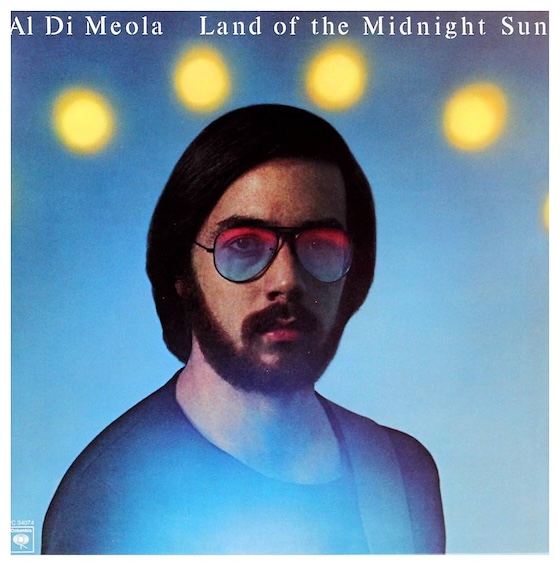
Some debut albums introduce an artist. Others arrive already in motion, fully combusted. Land of the Midnight Sun does the latter. It doesn’t ease in, doesn’t posture, doesn’t bother with polite handshakes. It rips open.
Fresh off his incandescent work with Al Di Meola in Chick Corea’s Return to Forever, this 1976 debut feels less like a first statement than a controlled detonation. Di Meola was barely in his twenties, which still feels absurd when you hear the precision, the velocity, the frightening composure. There’s youthful bravado here, sure—but sharpened into something almost predatory.
The title track opens like circuitry catching fire. Notes don’t merely cascade, they attack. Yet what makes this record endure isn’t speed—plenty could shred, few could phrase like this. Di Meola plays as though rhythm itself were something to be hunted. His picking is legendary for a reason, but what often gets overlooked is how melodic these compositions remain amid the pyrotechnics. Even at its most fevered, Land of the Midnight Sun never collapses into sterile virtuoso exhibitionism. It sweats. It breathes.
And what a cast surrounding him. Jaco Pastorius coils through “Golden Dawn” with that liquid, impossible bass language of his, while Paco de Lucía appears in flashes that feel almost mythic. Stanley Clarke and Lenny White don’t accompany each other so much as provoke. The whole record has that classic fusion-era excess—yes—but in the best sense: too many ideas, too much heat, too much technical delirium to behave itself.
Then there’s “Sarabande from Violin Sonata in B Minor.” That’s where the album mutates. Suddenly the electric blaze gives way to shadow and discipline. Di Meola’s relationship with classical form peeks through, not as affectation but architecture. It hints at where he'd wander later, but more importantly, it deepens this record’s strange emotional pull. Beneath all the velocity is melancholy. Beneath the flash, obsession.
What makes this album feel alive fifty years later is that it doesn’t sound museum-bound. It still has teeth. Modern progressive metal, technical death metal, fusion revivalists—so much of it drinks from this well whether it admits it or not. The angularity, the precision-as-aggression, the ecstatic complexity—it's all latent here. You can hear future genres twitching under the fretwork.
And yet this isn’t merely a “guitar player’s guitar album.” That label always shrinks records like this. Land of the Midnight Sun is mood-drunk, cosmic, occasionally unhinged. It has the sci-fi gleam of seventies fusion but also the dangerous improvisatory edge that made that era matter. It wasn’t about showing what could be played. It was about finding out what music could survive.
For a debut, it borders on arrogant. Good. Because it earns it.
This wasn’t the arrival of a prodigy. It was the announcement of a force already moving too fast to stop. This is fusion at its feral peak—virtuosity with venom, elegance with a knife in its boot. A midnight sun indeed: blinding, strange, and burning where darkness should be.
Drop the needle. Stay there. The night has its own frequency.