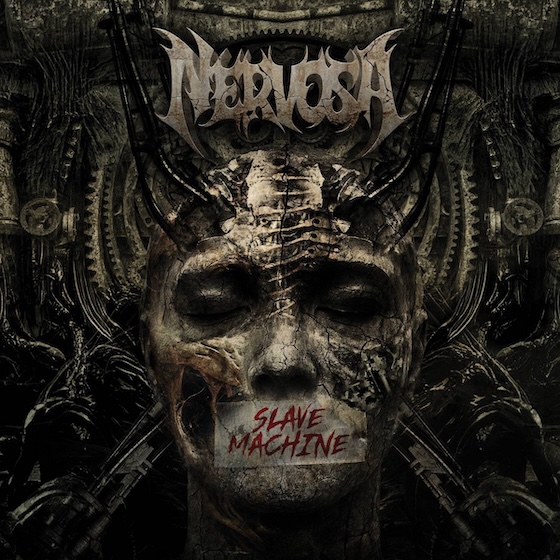
There’s a particular kind of violence that comes out of São Paulo, and Nervosa channels it with frightening precision on Slave Machine. This Brazilian thrash/death metal band doesn’t trade in polished aggression or retro-thrash cosplay; they sound too furious for nostalgia. The album erupts with “Impending Doom,” a track that hits like riot sirens over collapsing concrete, immediately establishing the record’s pulse—fast, abrasive, and hostile. Then the title track “Slave Machine” digs even deeper, locking into a punishing groove where the riffs don’t simply attack, they swarm. There’s something beautifully unstable about the way this record moves, always threatening collapse but never losing control.
A huge part of that force comes from the band itself. Vocalist and guitarist Prika Amaral is the album’s burning center, throwing out riffs with serrated precision while her vocals sound less performed than spat from a wound. There’s no separation between rage and musicianship; it all arrives in one violent surge. Guitarist Helena Kotina adds another blade to the attack, sharpening the harmonic edges and helping give the record its jagged, constantly shifting momentum. On bass, Hel Pyre and Emmelie Herwegh bring low-end menace that doesn’t just support the songs but prowls through them, while drummer Michaela Naydenova drives the whole thing with a performance that feels ferocious without becoming sterile or mechanical. The chemistry in this group matters. You can hear it.
What makes Slave Machine so compelling is how alive its ugliness feels. “Ghost Notes” jerks the momentum into something twitchy and unpredictable, while “Beast of Burden” stomps with this ugly mechanical weight that feels almost industrial. “You Are Not a Hero” lands like a manifesto in the middle of the chaos, sharp and confrontational, and “Hate” distills pure venom into four relentless minutes. The sequencing is part of the magic—twelve tracks, no wasted motion, no filler, just a constant tightening of pressure. “The New Empire” burns quick and mean, “30 Seconds” feels like a panic attack rendered in riffs, and “Crawling For Your Pride” leaves this sudden aftershock that makes you want to start it over immediately. Even “Learn Or Repeat,” with its cyclical title and ruthless momentum, feels like a thesis statement for the whole record.
There’s a raw, suffocating quality to the production that some might call cramped, but I’d argue it serves the album. This shouldn’t breathe easily. It should choke. The density makes “The Call” and “Speak in Fire” feel even more apocalyptic, as if the whole record has been building toward combustion. And that’s where Slave Machine transcends being merely a savage thrash/death release—it develops atmosphere.
That matters. This album plays like industrial body horror in audio form: sparks in dark corridors, assembly lines gone feral, machinery developing a grudge. I kept picturing rusted factory nightmares while listening, which may sound overblown, but the album practically demands imagery.
What separates Slave Machine from disposable aggression is personality. A lot of extreme metal chases brutality; Nervosa sounds possessed by it. There are little imperfections, moments where transitions stumble or riffs smear together in the assault, but those “mistakes” feel human, even necessary. You hear fingerprints on the blade. That roughness gives the record its identity. It doesn’t ask to be liked, and it certainly doesn’t care about accessibility. It dares endurance.
As a statement from São Paulo’s underground—now sharpened by an international lineup—it feels less like a record than an act of resistance wired directly into exposed tissue. A machine fed on fear, rage, and memory, learning to move on its own. And when it finally speaks in fire, it doesn’t sound triumphant.
It sounds hungry.
Nervosa’s latest release can be found here or wherever the finest metal offerings are being forged.
As always, remember: Celluloid fades. Dissonance lingers.