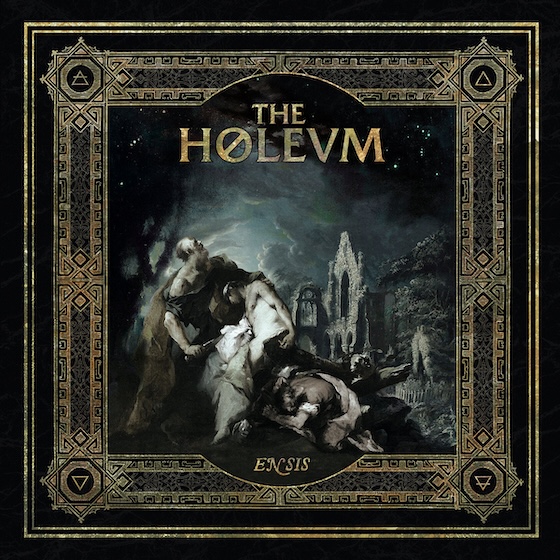
Spinning into the void, The Holeum return with their third transmission, Ensis—a gravitational collapse of sound where melodic bleakness fuses with blackened force. What emerges isn’t just heavier—it’s denser, more volatile, a record that trades in tension between violence and fragility until both feel indistinguishable. This isn’t expansion—it’s implosion. The band tightens its orbit and lets the mass do the damage.
At the center of it all is Pablo Egido, his vocals and droning undercurrent acting like a signal beamed from somewhere far beyond reach—part sermon, part warning. Around him, Luis Albadalejo and Julián Velasco form a dual-guitar axis, their work less about traditional riffing and more about distortion of space—melodies stretching, colliding, and collapsing into something unstable and luminous. Beneath them, Paco Porcel’s bass hums like dark matter, an unseen force binding everything together, while Miguel Fernández drives it forward with drumming that feels less like rhythm and more like controlled detonation, constantly shifting the ground beneath each passage.
And with this third album, the Spain-based unit distill everything they’ve been building toward into a singular, crushing force—music that behaves like a black hole, dense, inescapable, and all-consuming. Simply put, this is staggering.
“The Fermi Paradox” opens the record like a question with no answer—tense, searching, already unraveling at the edges. It doesn’t so much begin as coalesce, fragments pulling together under unseen pressure into something ominous, unresolved, and quietly devastating.
From there, “Cosmic Void Spheres” and “Macrocosm + Microcosm” widen the scope until the record feels less like a sequence of tracks and more like a haunted expanse—cold, alien, and permanently scarred. The guitars drift in long, spectral arcs, shimmering one moment and collapsing into suffocating weight the next, while the low end pulses like something buried and restless beneath the surface. The drums move with an uneasy, almost sentient push and pull, never settling, always dragging the listener further off balance. Over it all, the vocals arrive like a distant signal—half-erased, half-commanding—echoing through the void with a presence that feels both human and not. There are fragments of groove hidden in the wreckage, slow, hypnotic movements that almost cohere into something familiar, but they’re quickly warped, stretched, and torn apart.
“Spontaneous Synchronization” introduces a colder, more mechanical tension—precision without comfort—while “Hyperdimensional Physics” fractures time outright, snapping between crushing density and eerie suspension as if the band is testing how far structure can be pushed before it disintegrates. By the time Ensis reaches “Esoteric Futuristic Visions” and the closing spiral of “Geometric Congruence Vortex,” any remaining sense of grounding has been stripped away. What’s left is drift—melodies dissolving into drones, aggression mutating into something distant and unknowable, the entire record folding inward on itself like a dying star.
Ensis doesn’t build on what came before—it compresses it, crushes it, and reshapes it into something far more alien. This is The Holeum at their most focused and most unforgiving, a record that doesn’t just pull you into the void—it leaves a mark on the way down, scarred and irreversible.
Ensis is available directly from the band via their Bandcamp page—where you can pick it up on limited vinyl, CD digipak, or high-quality digital formats. Digital downloads are offered in multiple formats (including 24-bit), while physical editions include special pressings like the gold/black sunburst LP.
You can step into it here: Enter the void and purchase Ensis
And as always—
Celluloid fades. Dissonance remains.